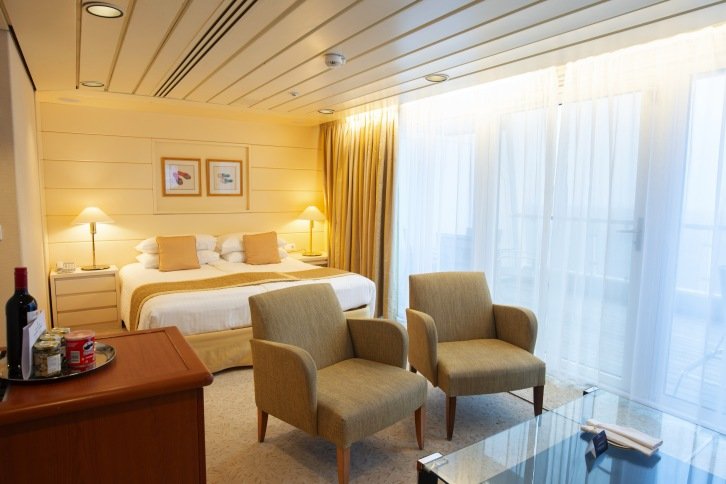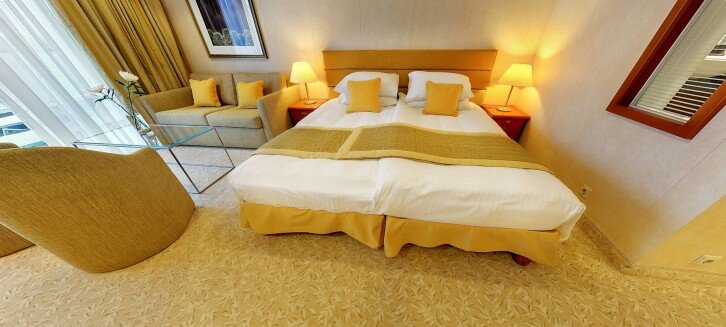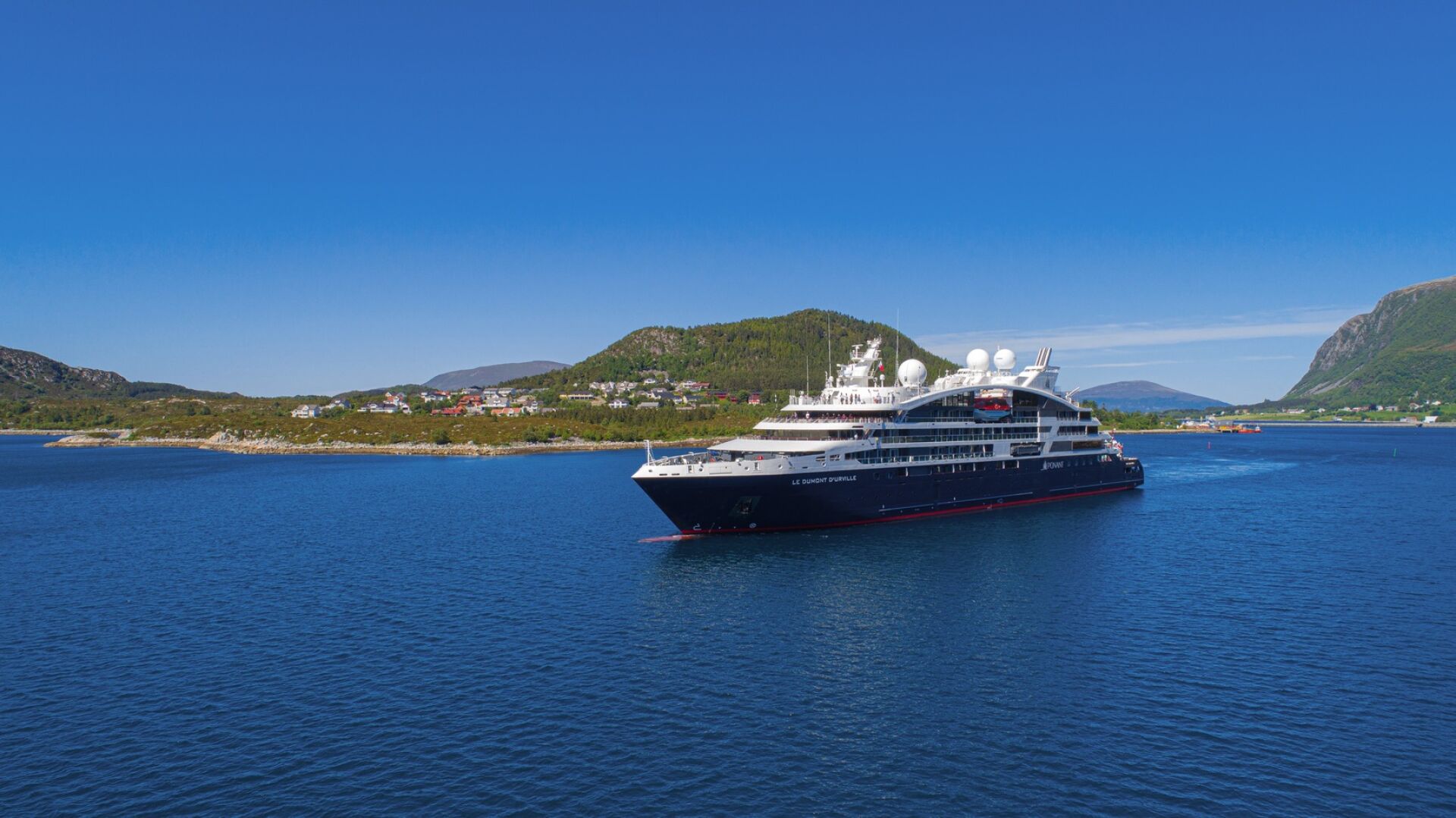



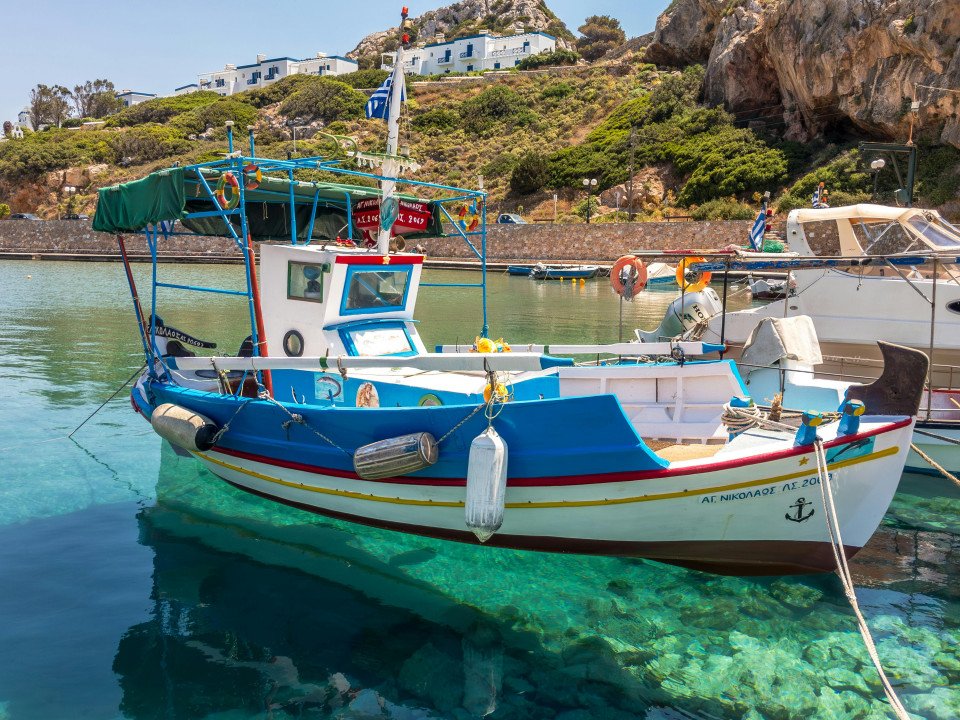
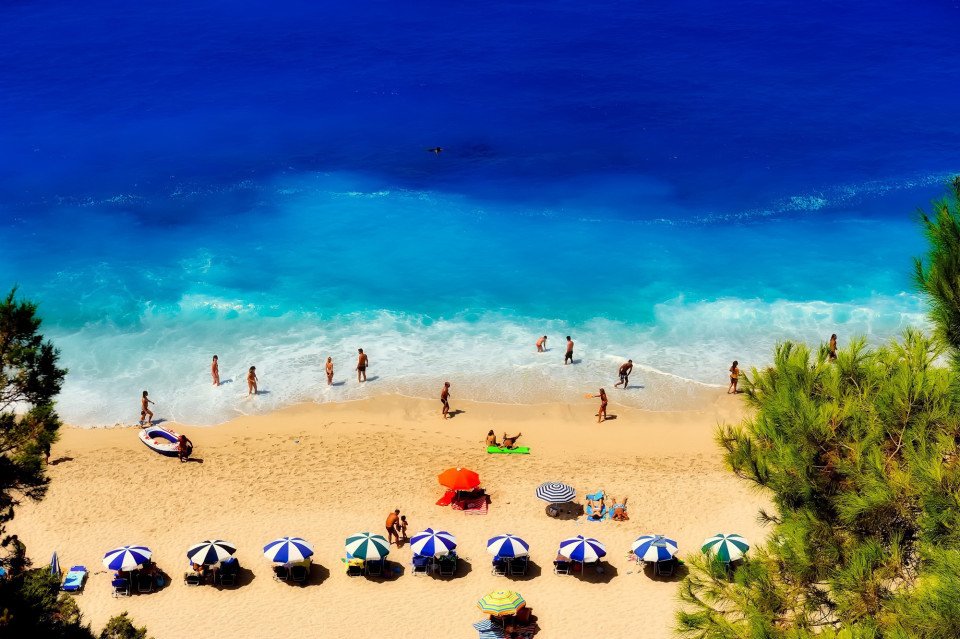
Greek Islands, Adriatic & Turkish Riviera
Piraeus | Ermoupoli, Syra | Kos | Agios Nikólaos, Kríti | Santorini | Piraeus | Sarandë | Koper | Ancona | Sibenik | Dubrovnik | Kotor | Piraeus | Bodrum | More...
(Prices correct as of today’s date, are updated daily, are subject to change and represent genuine availability at time of update).
Cruise only holidays are financially protected by ABTA. Fly cruise holidays are financially protected by Fred Olsen Cruise Lines under ATOL number 5016
Please click here to check the essential travel requirements before booking this cruise.
Call our cruise experts now and customise your cruise with flights, hotels, land tours and more
Prices based on 2 people sharing. Cruise only price does not include flights. Fly-cruise price is based on departures from LON, MAN (LON, MAN) and may vary by chosen UK airport. Please call for other flight options

Prices based on 1 solo passenger. Cruise only price does not include flights. Fly-cruise price may vary by chosen UK airport.
Prices based on 3 people sharing. Cruise only price does not include flights. Fly-cruise price may vary by chosen UK airport.
Prices based on 4 people sharing. Cruise only price does not include flights. Fly-cruise price may vary by chosen UK airport.
Piraeus
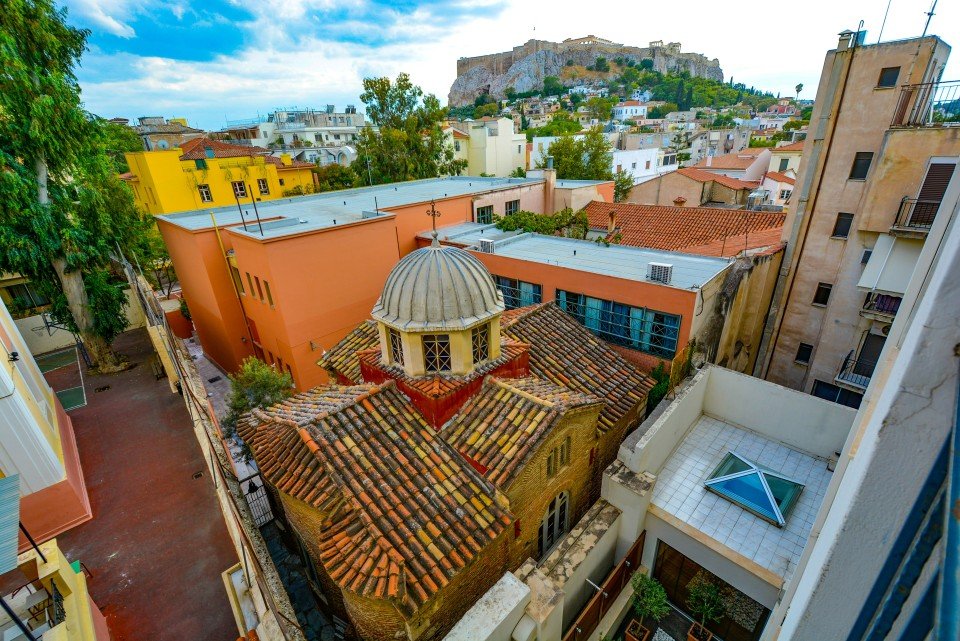
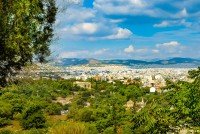
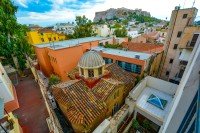
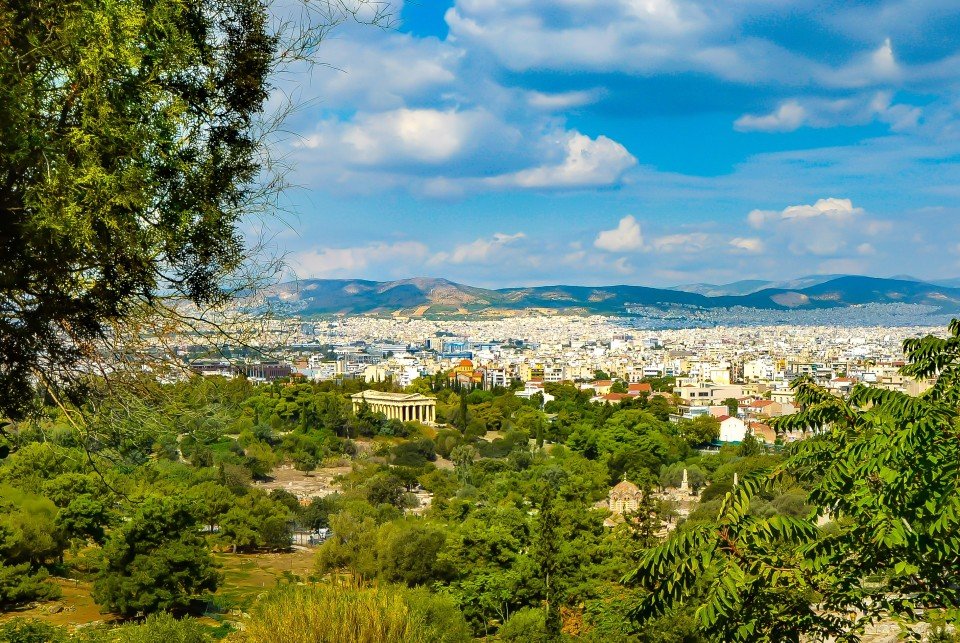
It's no wonder that all roads lead to the fascinating and maddening metropolis of Athens. Lift your eyes 200 feet above the city to the Parthenon, its honey-color marble columns rising from a massive limestone base, and you behold architectural perfection that has not been surpassed in 2,5... It's no wonder that all roads lead to the fascinating and maddening metropolis of Athens. Lift your eyes 200 feet above the city to the Parthenon, its honey-color marble columns rising from a massive limestone base, and you behold architectural perfection that has not been surpassed in 2,500 years. But, today, this shrine of classical form dominates a 21st-century boomtown. To experience Athens—Athína in Greek—fully is to understand the essence of Greece: ancient monuments surviving in a sea of cement, startling beauty amid the squalor, tradition juxtaposed with modernity. Locals depend on humor and flexibility to deal with the chaos; you should do the same. The rewards are immense. Although Athens covers a huge area, the major landmarks of the ancient Greek, Roman, and Byzantine periods are close to the modern city center. You can easily walk from the Acropolis to many other key sites, taking time to browse in shops and relax in cafés and tavernas along the way. From many quarters of the city you can glimpse "the glory that was Greece" in the form of the Acropolis looming above the horizon, but only by actually climbing that rocky precipice can you feel the impact of the ancient settlement. The Acropolis and Filopappou, two craggy hills sitting side by side; the ancient Agora (marketplace); and Kerameikos, the first cemetery, form the core of ancient and Roman Athens. Along the Unification of Archaeological Sites promenade, you can follow stone-paved, tree-lined walkways from site to site, undisturbed by traffic. Cars have also been banned or reduced in other streets in the historical center. In the National Archaeological Museum, vast numbers of artifacts illustrate the many millennia of Greek civilization; smaller museums such as the Goulandris Museum of Cycladic Art Museum and the Byzantine and Christian Museum illuminate the history of particular regions or periods. Athens may seem like one huge city, but it is really a conglomeration of neighborhoods with distinctive characters. The Eastern influences that prevailed during the 400-year rule of the Ottoman Empire are still evident in Monastiraki, the bazaar area near the foot of the Acropolis. On the northern slope of the Acropolis, stroll through Plaka (if possible by moonlight), an area of tranquil streets lined with renovated mansions, to get the flavor of the 19th-century's gracious lifestyle. The narrow lanes of Anafiotika, a section of Plaka, thread past tiny churches and small, color-washed houses with wooden upper stories, recalling a Cycladic island village. In this maze of winding streets, vestiges of the older city are everywhere: crumbling stairways lined with festive tavernas; dank cellars filled with wine vats; occasionally a court or diminutive garden, enclosed within high walls and filled with magnolia trees and the flaming trumpet-shaped flowers of hibiscus bushes. Formerly run-down old quarters, such as Thission, Gazi and Psirri, popular nightlife areas filled with bars and mezedopoleia (similar to tapas bars), are now in the process of gentrification, although they still retain much of their original charm, as does the colorful produce and meat market on Athinas. The area around Syntagma Square, the tourist hub, and Omonia Square, the commercial heart of the city about 1 km (½ mi) northwest, is distinctly European, having been designed by the court architects of King Otho, a Bavarian, in the 19th century. The chic shops and bistros of ritzy Kolonaki nestle at the foot of Mt. Lycabettus, Athens's highest hill (909 feet). Each of Athens's outlying suburbs has a distinctive character: in the north is wealthy, tree-lined Kifissia, once a summer resort for aristocratic Athenians, and in the south and southeast lie Glyfada, Voula, and Vouliagmeni, with their sandy beaches, seaside bars, and lively summer nightlife. Just beyond the city's southern fringes is Piraeus, a bustling port city of waterside fish tavernas and Saronic Gulf views. Read More
Piraeus
It's no wonder that all roads lead to the fascinating and maddening metropolis of Athens. Lift your eyes 200 feet above the city to the Parthenon, its honey-color marble columns rising from a massive limestone base, and you behold architectural perfection that has not been surpassed in 2,5... It's no wonder that all roads lead to the fascinating and maddening metropolis of Athens. Lift your eyes 200 feet above the city to the Parthenon, its honey-color marble columns rising from a massive limestone base, and you behold architectural perfection that has not been surpassed in 2,500 years. But, today, this shrine of classical form dominates a 21st-century boomtown. To experience Athens—Athína in Greek—fully is to understand the essence of Greece: ancient monuments surviving in a sea of cement, startling beauty amid the squalor, tradition juxtaposed with modernity. Locals depend on humor and flexibility to deal with the chaos; you should do the same. The rewards are immense. Although Athens covers a huge area, the major landmarks of the ancient Greek, Roman, and Byzantine periods are close to the modern city center. You can easily walk from the Acropolis to many other key sites, taking time to browse in shops and relax in cafés and tavernas along the way. From many quarters of the city you can glimpse "the glory that was Greece" in the form of the Acropolis looming above the horizon, but only by actually climbing that rocky precipice can you feel the impact of the ancient settlement. The Acropolis and Filopappou, two craggy hills sitting side by side; the ancient Agora (marketplace); and Kerameikos, the first cemetery, form the core of ancient and Roman Athens. Along the Unification of Archaeological Sites promenade, you can follow stone-paved, tree-lined walkways from site to site, undisturbed by traffic. Cars have also been banned or reduced in other streets in the historical center. In the National Archaeological Museum, vast numbers of artifacts illustrate the many millennia of Greek civilization; smaller museums such as the Goulandris Museum of Cycladic Art Museum and the Byzantine and Christian Museum illuminate the history of particular regions or periods. Athens may seem like one huge city, but it is really a conglomeration of neighborhoods with distinctive characters. The Eastern influences that prevailed during the 400-year rule of the Ottoman Empire are still evident in Monastiraki, the bazaar area near the foot of the Acropolis. On the northern slope of the Acropolis, stroll through Plaka (if possible by moonlight), an area of tranquil streets lined with renovated mansions, to get the flavor of the 19th-century's gracious lifestyle. The narrow lanes of Anafiotika, a section of Plaka, thread past tiny churches and small, color-washed houses with wooden upper stories, recalling a Cycladic island village. In this maze of winding streets, vestiges of the older city are everywhere: crumbling stairways lined with festive tavernas; dank cellars filled with wine vats; occasionally a court or diminutive garden, enclosed within high walls and filled with magnolia trees and the flaming trumpet-shaped flowers of hibiscus bushes. Formerly run-down old quarters, such as Thission, Gazi and Psirri, popular nightlife areas filled with bars and mezedopoleia (similar to tapas bars), are now in the process of gentrification, although they still retain much of their original charm, as does the colorful produce and meat market on Athinas. The area around Syntagma Square, the tourist hub, and Omonia Square, the commercial heart of the city about 1 km (½ mi) northwest, is distinctly European, having been designed by the court architects of King Otho, a Bavarian, in the 19th century. The chic shops and bistros of ritzy Kolonaki nestle at the foot of Mt. Lycabettus, Athens's highest hill (909 feet). Each of Athens's outlying suburbs has a distinctive character: in the north is wealthy, tree-lined Kifissia, once a summer resort for aristocratic Athenians, and in the south and southeast lie Glyfada, Voula, and Vouliagmeni, with their sandy beaches, seaside bars, and lively summer nightlife. Just beyond the city's southern fringes is Piraeus, a bustling port city of waterside fish tavernas and Saronic Gulf views. Read More
Ermoupoli, Syra
Syros is an island in the Aegean Sea, 78 miles (125 kilometres) southeast of Athens, and the administrative, commercial, intellectual and cultural centre of the Cyclades. Syros is 32 square miles (82.8 square kilometres) in area. Its largest towns are Ermoupoli, the capital of the island a... Syros is an island in the Aegean Sea, 78 miles (125 kilometres) southeast of Athens, and the administrative, commercial, intellectual and cultural centre of the Cyclades. Syros is 32 square miles (82.8 square kilometres) in area. Its largest towns are Ermoupoli, the capital of the island and Cyclades, Ano Syros and Vari. Although Syros belongs to the Cyclades islands, its architecture is more medieval than Cycladic. The beaches of Syros are especially inviting, and surrounded by many tourist facilities and accommodations. Read More
Santorini
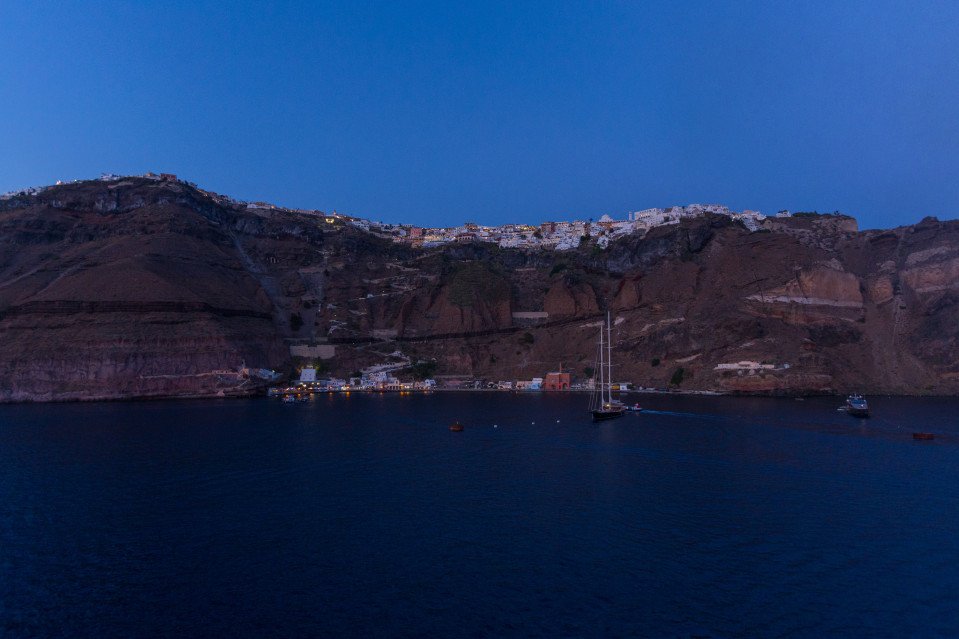
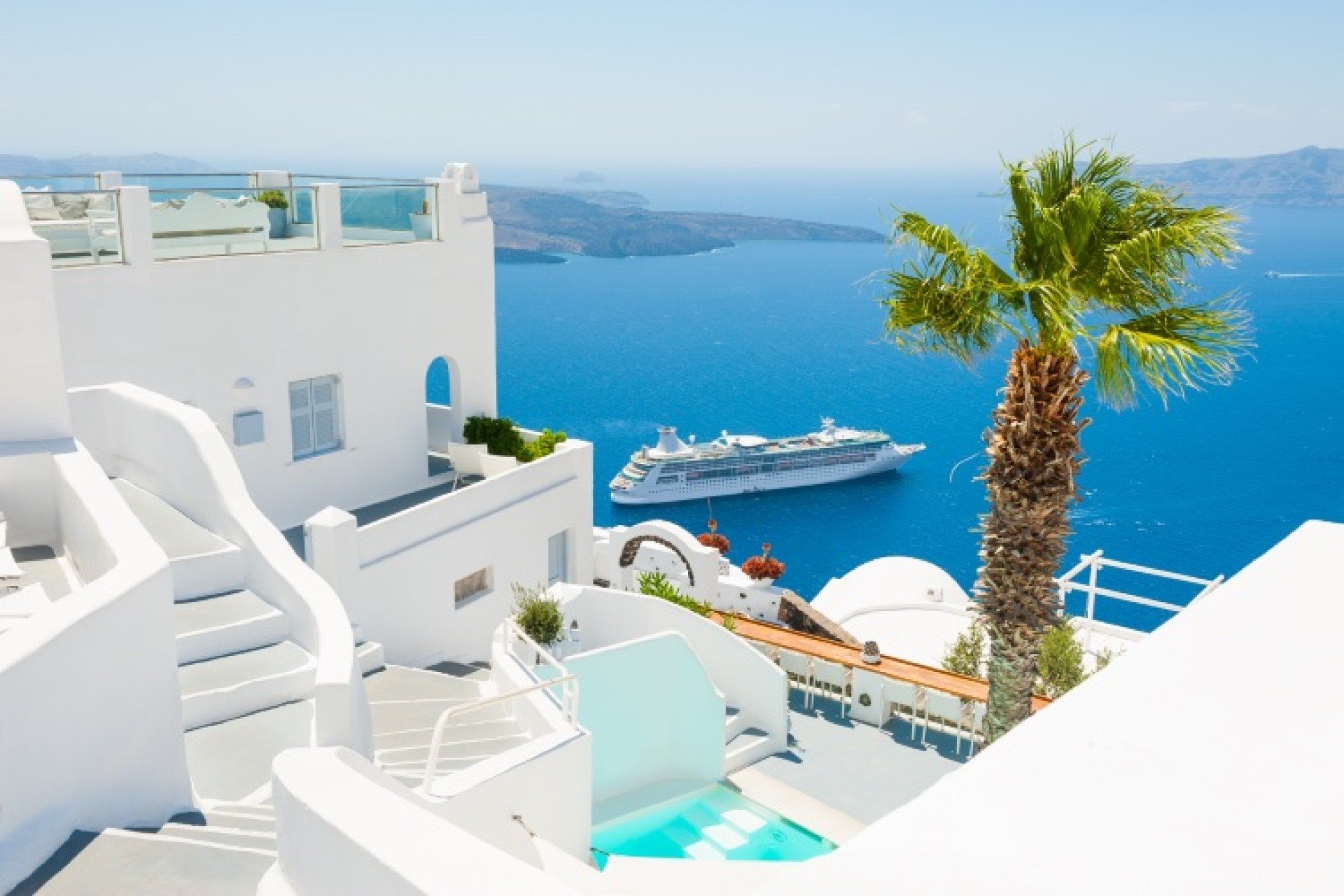
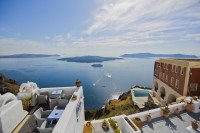
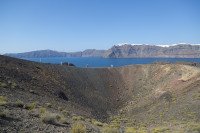
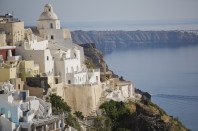
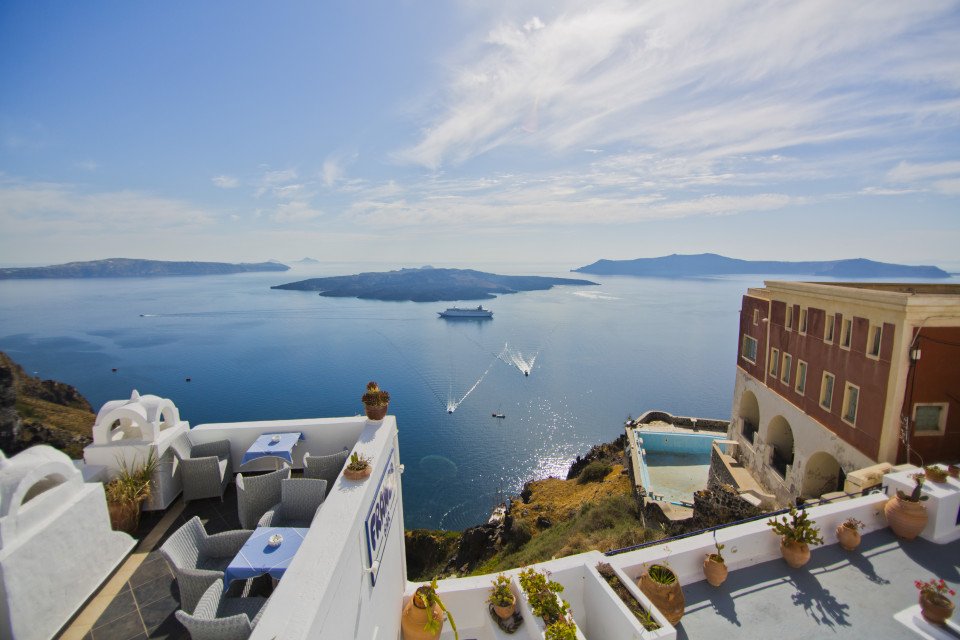
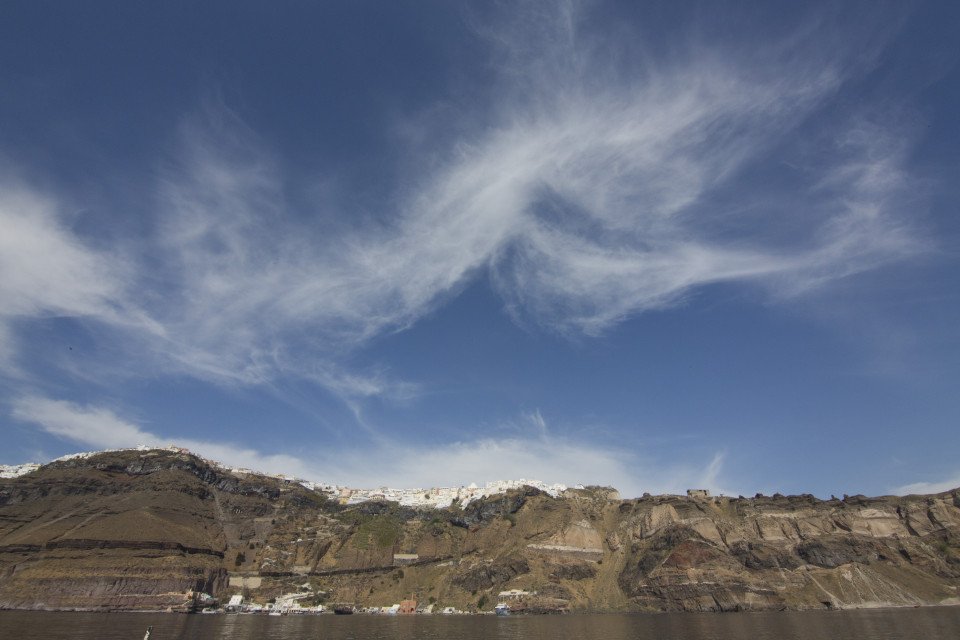
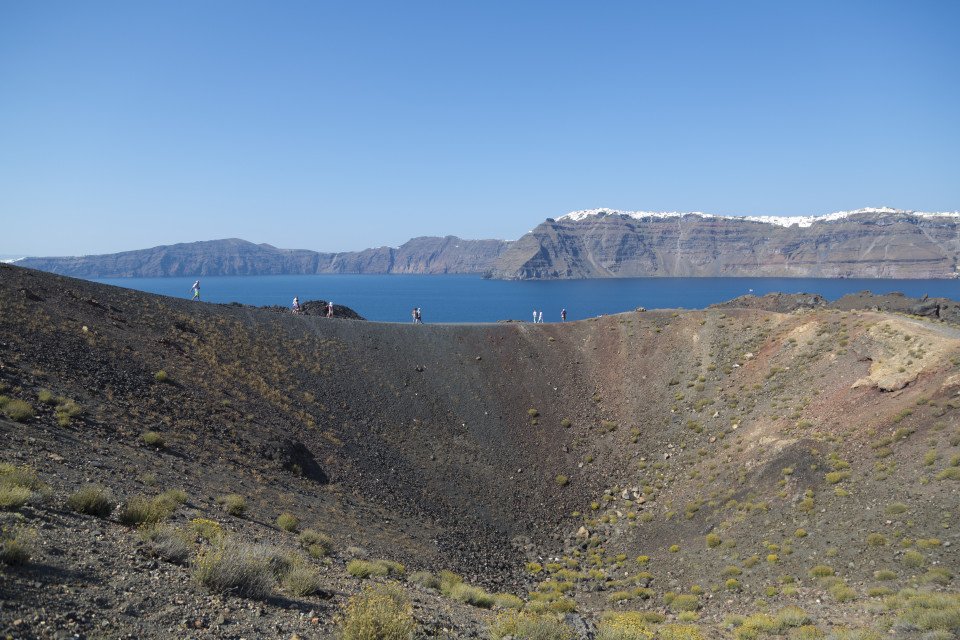
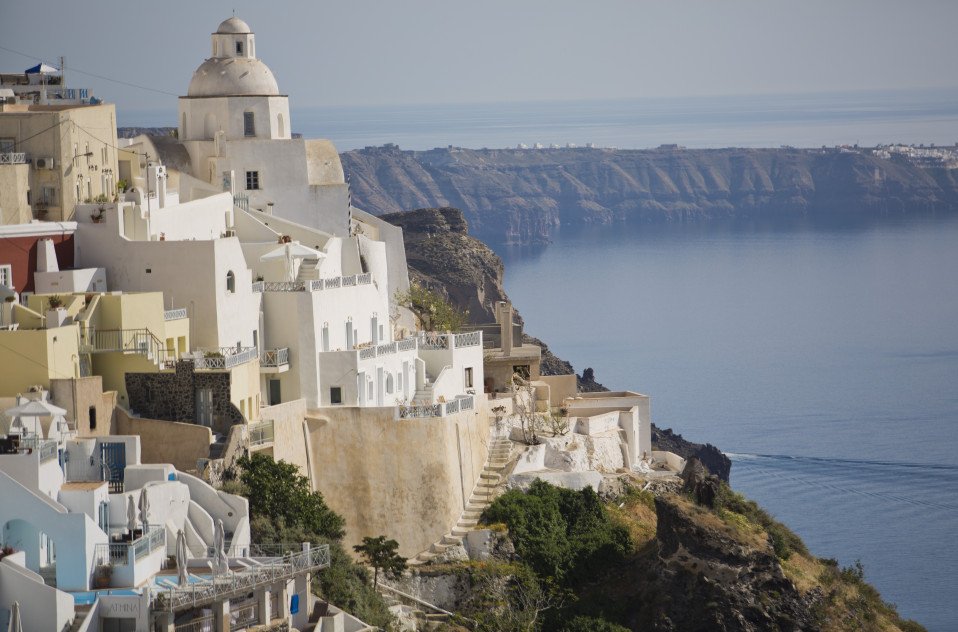
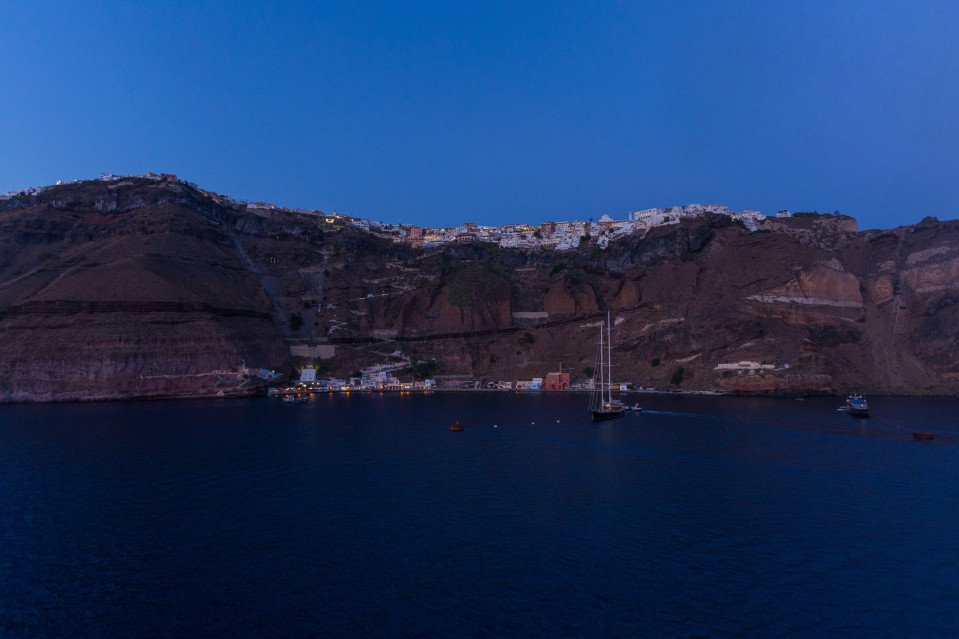
Undoubtedly the most extraordinary island in the Aegean, crescent-shape Santorini remains a mandatory stop on the Cycladic tourist route—even if it's necessary to enjoy the sensational sunsets from Ia, the fascinating excavations, and the dazzling white towns with a million other travelers... Undoubtedly the most extraordinary island in the Aegean, crescent-shape Santorini remains a mandatory stop on the Cycladic tourist route—even if it's necessary to enjoy the sensational sunsets from Ia, the fascinating excavations, and the dazzling white towns with a million other travelers. Called Kállisti (the "Loveliest") when first settled, the island has now reverted to its subsequent name of Thira, after the 9th-century-BC Dorian colonizer Thiras. The place is better known, however, these days as Santorini, a name derived from its patroness, St. Irene of Thessaloniki, the Byzantine empress who restored icons to Orthodoxy and died in 802. You can fly conveniently to Santorini, but to enjoy a true Santorini rite of passage, opt instead for the boat trip here, which provides a spectacular introduction. After the boat sails between Sikinos and Ios, your deck-side perch approaches two close islands with a passage between them. The bigger one on the left is Santorini, and the smaller on the right is Thirassia. Passing between them, you see the village of Ia adorning Santorini's northernmost cliff like a white geometric beehive. You are in the caldera (volcanic crater), one of the world's truly breathtaking sights: a demilune of cliffs rising 1,100 feet, with the white clusters of the towns of Fira and Ia perched along the top. The bay, once the high center of the island, is 1,300 feet in some places, so deep that when boats dock in Santorini's shabby little port of Athinios, they do not drop anchor. The encircling cliffs are the ancient rim of a still-active volcano, and you are sailing east across its flooded caldera. On your right are the Burnt isles, the White isle, and other volcanic remnants, all lined up as if some outsize display in a geology museum. Hephaestus's subterranean fires smolder still—the volcano erupted in 198 BC, about 735, and there was an earthquake in 1956. Indeed, Santorini and its four neighboring islets are the fragmentary remains of a larger landmass that exploded about 1600 BC: the volcano's core blew sky high, and the sea rushed into the abyss to create the great bay, which measures 10 km by 7 km (6 mi by 4½ mi) and is 1,292 feet deep. The other pieces of the rim, which broke off in later eruptions, are Thirassia, where a few hundred people live, and deserted little Aspronissi ("White isle"). In the center of the bay, black and uninhabited, two cones, the Burnt Isles of Palea Kameni and Nea Kameni, appeared between 1573 and 1925. There has been too much speculation about the identification of Santorini with the mythical Atlantis, mentioned in Egyptian papyri and by Plato (who says it's in the Atlantic), but myths are hard to pin down. This is not true of old arguments about whether tidal waves from Santorini's cataclysmic explosion destroyed Minoan civilization on Crete, 113 km (70 mi) away. The latest carbon-dating evidence, which points to a few years before 1600 BC for the eruption, clearly indicates that the Minoans outlasted the eruption by a couple of hundred years, but most probably in a weakened state. In fact, the island still endures hardships: since antiquity, Santorini has depended on rain collected in cisterns for drinking and irrigating—the well water is often brackish—and the serious shortage is alleviated by the importation of water. However, the volcanic soil also yields riches: small, intense tomatoes with tough skins used for tomato paste (good restaurants here serve them); the famous Santorini fava beans, which have a light, fresh taste; barley; wheat; and white-skin eggplants. Read More
Piraeus
It's no wonder that all roads lead to the fascinating and maddening metropolis of Athens. Lift your eyes 200 feet above the city to the Parthenon, its honey-color marble columns rising from a massive limestone base, and you behold architectural perfection that has not been surpassed in 2,5... It's no wonder that all roads lead to the fascinating and maddening metropolis of Athens. Lift your eyes 200 feet above the city to the Parthenon, its honey-color marble columns rising from a massive limestone base, and you behold architectural perfection that has not been surpassed in 2,500 years. But, today, this shrine of classical form dominates a 21st-century boomtown. To experience Athens—Athína in Greek—fully is to understand the essence of Greece: ancient monuments surviving in a sea of cement, startling beauty amid the squalor, tradition juxtaposed with modernity. Locals depend on humor and flexibility to deal with the chaos; you should do the same. The rewards are immense. Although Athens covers a huge area, the major landmarks of the ancient Greek, Roman, and Byzantine periods are close to the modern city center. You can easily walk from the Acropolis to many other key sites, taking time to browse in shops and relax in cafés and tavernas along the way. From many quarters of the city you can glimpse "the glory that was Greece" in the form of the Acropolis looming above the horizon, but only by actually climbing that rocky precipice can you feel the impact of the ancient settlement. The Acropolis and Filopappou, two craggy hills sitting side by side; the ancient Agora (marketplace); and Kerameikos, the first cemetery, form the core of ancient and Roman Athens. Along the Unification of Archaeological Sites promenade, you can follow stone-paved, tree-lined walkways from site to site, undisturbed by traffic. Cars have also been banned or reduced in other streets in the historical center. In the National Archaeological Museum, vast numbers of artifacts illustrate the many millennia of Greek civilization; smaller museums such as the Goulandris Museum of Cycladic Art Museum and the Byzantine and Christian Museum illuminate the history of particular regions or periods. Athens may seem like one huge city, but it is really a conglomeration of neighborhoods with distinctive characters. The Eastern influences that prevailed during the 400-year rule of the Ottoman Empire are still evident in Monastiraki, the bazaar area near the foot of the Acropolis. On the northern slope of the Acropolis, stroll through Plaka (if possible by moonlight), an area of tranquil streets lined with renovated mansions, to get the flavor of the 19th-century's gracious lifestyle. The narrow lanes of Anafiotika, a section of Plaka, thread past tiny churches and small, color-washed houses with wooden upper stories, recalling a Cycladic island village. In this maze of winding streets, vestiges of the older city are everywhere: crumbling stairways lined with festive tavernas; dank cellars filled with wine vats; occasionally a court or diminutive garden, enclosed within high walls and filled with magnolia trees and the flaming trumpet-shaped flowers of hibiscus bushes. Formerly run-down old quarters, such as Thission, Gazi and Psirri, popular nightlife areas filled with bars and mezedopoleia (similar to tapas bars), are now in the process of gentrification, although they still retain much of their original charm, as does the colorful produce and meat market on Athinas. The area around Syntagma Square, the tourist hub, and Omonia Square, the commercial heart of the city about 1 km (½ mi) northwest, is distinctly European, having been designed by the court architects of King Otho, a Bavarian, in the 19th century. The chic shops and bistros of ritzy Kolonaki nestle at the foot of Mt. Lycabettus, Athens's highest hill (909 feet). Each of Athens's outlying suburbs has a distinctive character: in the north is wealthy, tree-lined Kifissia, once a summer resort for aristocratic Athenians, and in the south and southeast lie Glyfada, Voula, and Vouliagmeni, with their sandy beaches, seaside bars, and lively summer nightlife. Just beyond the city's southern fringes is Piraeus, a bustling port city of waterside fish tavernas and Saronic Gulf views. Read More
Piraeus
It's no wonder that all roads lead to the fascinating and maddening metropolis of Athens. Lift your eyes 200 feet above the city to the Parthenon, its honey-color marble columns rising from a massive limestone base, and you behold architectural perfection that has not been surpassed in 2,5... It's no wonder that all roads lead to the fascinating and maddening metropolis of Athens. Lift your eyes 200 feet above the city to the Parthenon, its honey-color marble columns rising from a massive limestone base, and you behold architectural perfection that has not been surpassed in 2,500 years. But, today, this shrine of classical form dominates a 21st-century boomtown. To experience Athens—Athína in Greek—fully is to understand the essence of Greece: ancient monuments surviving in a sea of cement, startling beauty amid the squalor, tradition juxtaposed with modernity. Locals depend on humor and flexibility to deal with the chaos; you should do the same. The rewards are immense. Although Athens covers a huge area, the major landmarks of the ancient Greek, Roman, and Byzantine periods are close to the modern city center. You can easily walk from the Acropolis to many other key sites, taking time to browse in shops and relax in cafés and tavernas along the way. From many quarters of the city you can glimpse "the glory that was Greece" in the form of the Acropolis looming above the horizon, but only by actually climbing that rocky precipice can you feel the impact of the ancient settlement. The Acropolis and Filopappou, two craggy hills sitting side by side; the ancient Agora (marketplace); and Kerameikos, the first cemetery, form the core of ancient and Roman Athens. Along the Unification of Archaeological Sites promenade, you can follow stone-paved, tree-lined walkways from site to site, undisturbed by traffic. Cars have also been banned or reduced in other streets in the historical center. In the National Archaeological Museum, vast numbers of artifacts illustrate the many millennia of Greek civilization; smaller museums such as the Goulandris Museum of Cycladic Art Museum and the Byzantine and Christian Museum illuminate the history of particular regions or periods. Athens may seem like one huge city, but it is really a conglomeration of neighborhoods with distinctive characters. The Eastern influences that prevailed during the 400-year rule of the Ottoman Empire are still evident in Monastiraki, the bazaar area near the foot of the Acropolis. On the northern slope of the Acropolis, stroll through Plaka (if possible by moonlight), an area of tranquil streets lined with renovated mansions, to get the flavor of the 19th-century's gracious lifestyle. The narrow lanes of Anafiotika, a section of Plaka, thread past tiny churches and small, color-washed houses with wooden upper stories, recalling a Cycladic island village. In this maze of winding streets, vestiges of the older city are everywhere: crumbling stairways lined with festive tavernas; dank cellars filled with wine vats; occasionally a court or diminutive garden, enclosed within high walls and filled with magnolia trees and the flaming trumpet-shaped flowers of hibiscus bushes. Formerly run-down old quarters, such as Thission, Gazi and Psirri, popular nightlife areas filled with bars and mezedopoleia (similar to tapas bars), are now in the process of gentrification, although they still retain much of their original charm, as does the colorful produce and meat market on Athinas. The area around Syntagma Square, the tourist hub, and Omonia Square, the commercial heart of the city about 1 km (½ mi) northwest, is distinctly European, having been designed by the court architects of King Otho, a Bavarian, in the 19th century. The chic shops and bistros of ritzy Kolonaki nestle at the foot of Mt. Lycabettus, Athens's highest hill (909 feet). Each of Athens's outlying suburbs has a distinctive character: in the north is wealthy, tree-lined Kifissia, once a summer resort for aristocratic Athenians, and in the south and southeast lie Glyfada, Voula, and Vouliagmeni, with their sandy beaches, seaside bars, and lively summer nightlife. Just beyond the city's southern fringes is Piraeus, a bustling port city of waterside fish tavernas and Saronic Gulf views. Read More
Sarandë
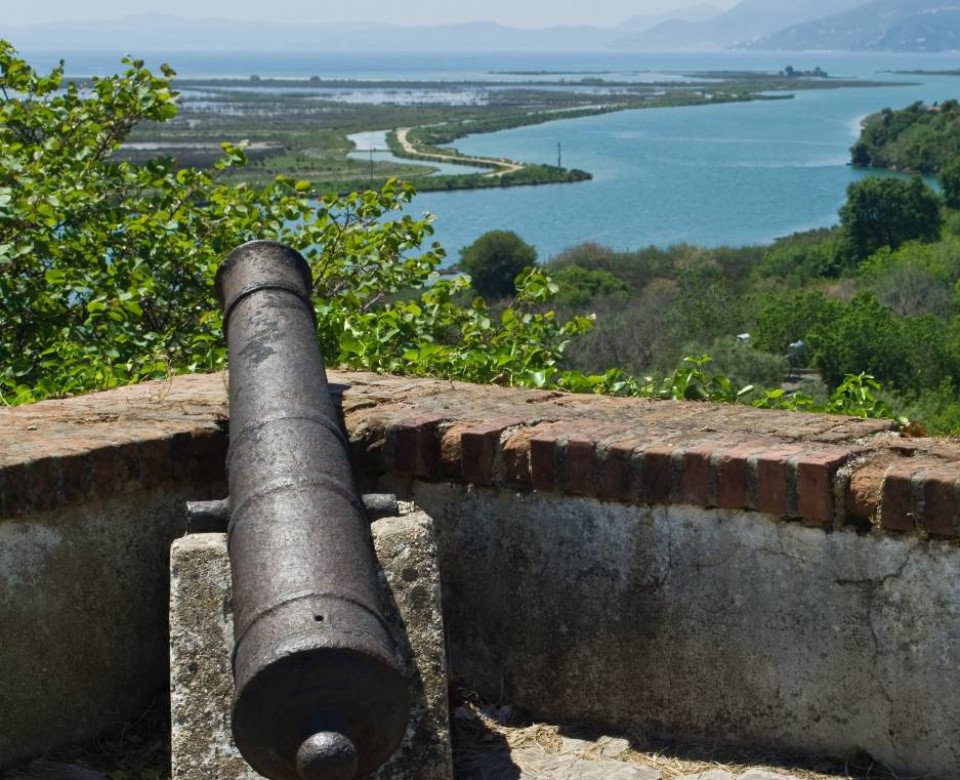
Sarandë is a city in southern Albania on the coast of the Ionian Sea. Sarandë can be reached easily from the Greek island of Corfu by ferry. An early Christian monastery dedicated to 40 saints (Santi Quaranta) gave Sarandë its name. The city center of Sarandë has been scarred by communist... Sarandë is a city in southern Albania on the coast of the Ionian Sea. Sarandë can be reached easily from the Greek island of Corfu by ferry. An early Christian monastery dedicated to 40 saints (Santi Quaranta) gave Sarandë its name. The city center of Sarandë has been scarred by communist architecture but since the fall of communism many small shops and bars have sprung up which give it a Mediterranean feel. This southernmost harbour of Albania was once the ancient port of Onchesmos. Today, Sarandë’s main attractions are its sunny climate and the nearby ruins of Butrint. Please Note: For your convenience, shore excursions offered for this port of call are available to reserve in advance at www.silversea.com, unless otherwise noted in the description. The deadline to reserve these tours is August 19, after which they will be available for purchase on board, unless otherwise noted in the description. Pier Information The ship is scheduled to anchor at Main Pier. The town center is 875 yards from the pier. Taxis are generally available at the pier. Shopping Typical souvenirs include t-shirts, postcards, wood carvings and dolls in national costume. Cuisine Albanian cuisine has been strongly influenced by Turkey. Grilled meats like shisqubap (shish kebab), romstek (minced meat patties) and gofte (meat balls) are served all across the Balkans. Some local dishes include comlek (meat and onion stew), fërges (a rich beef stew), rosto me salcë kosi (roast beef with sour cream) and tavë kosi (mutton with yoghurt. Lake Shkodra carp and Lake Ohrid trout are the most common fish dishes. Try the ice cream (akullore), which is popular everywhere. Other Sites Blue Eye Spring The iridescent blue water gushes from the depths of the earth and feeds the Bistrica River. Catacombs Recently discovered catacombs of the church of the Forty Saints can also be explored. Private arrangements for independent sightseeing may be requested through the Tour Office on board. Read More
Koper
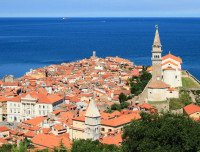
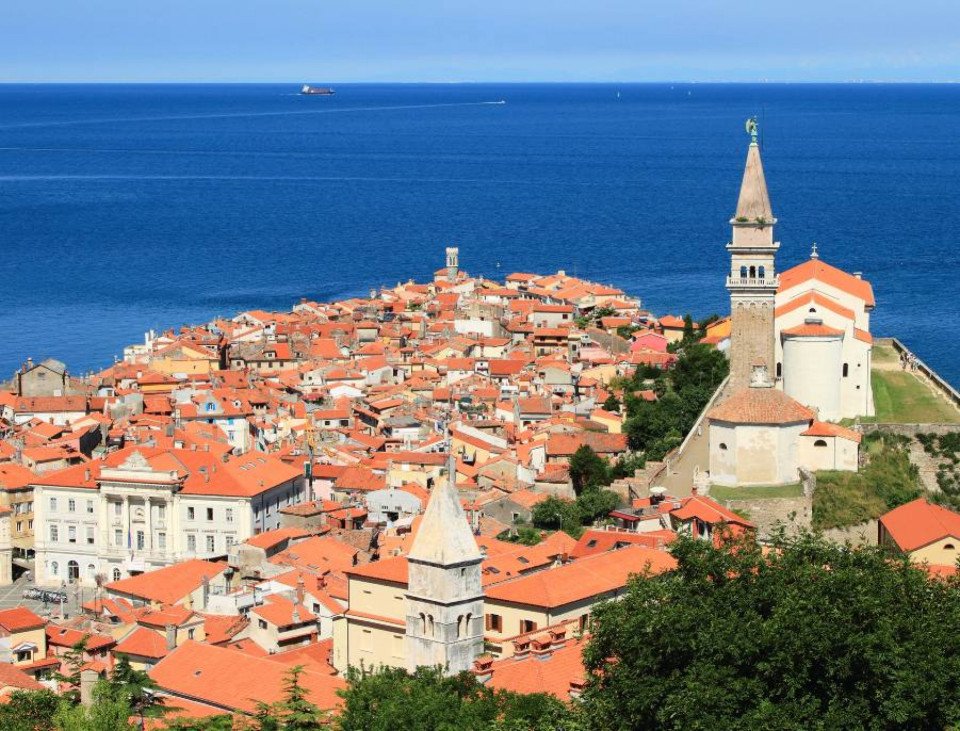
Today a port town surrounded by industrial suburbs, Koper nevertheless warrants a visit. The Republic of Venice made Koper the regional capital during the 15th and 16th centuries, and the magnificent architecture of the Old Town bears witness to the spirit of those times.The most important... Today a port town surrounded by industrial suburbs, Koper nevertheless warrants a visit. The Republic of Venice made Koper the regional capital during the 15th and 16th centuries, and the magnificent architecture of the Old Town bears witness to the spirit of those times.The most important buildings are clustered around Titov trg, the central town square. Here stands the Cathedral, which can be visited daily from 7 to noon and 3 to 7, with its fine Venetian Gothic facade and bell tower dating back to 1664. Across the square the splendid Praetor's Palace, formerly the seat of the Venetian Grand Council, combines Gothic and Renaissance styles. From the west side of Titov trg, the narrow, cobbled Kidriceva ulica brings you down to the seafront. Read More
Ancona
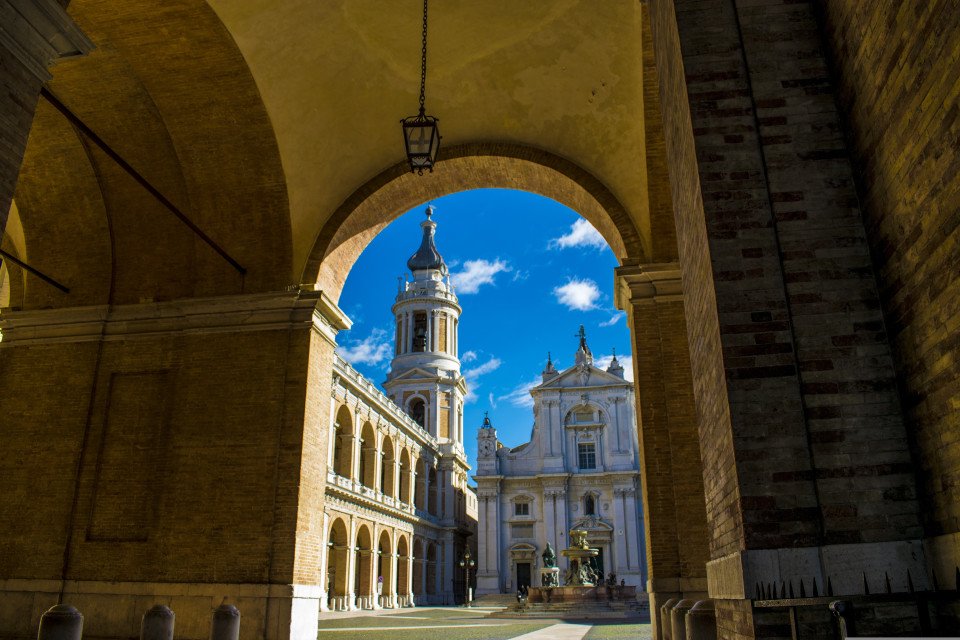
Ancona is the capital of Italy's Marche region. Ancona's main attraction is her tactile museum for the blinds. It's also a great place to take a dip and enjoy great sea views under the sunshine.
Sibenik
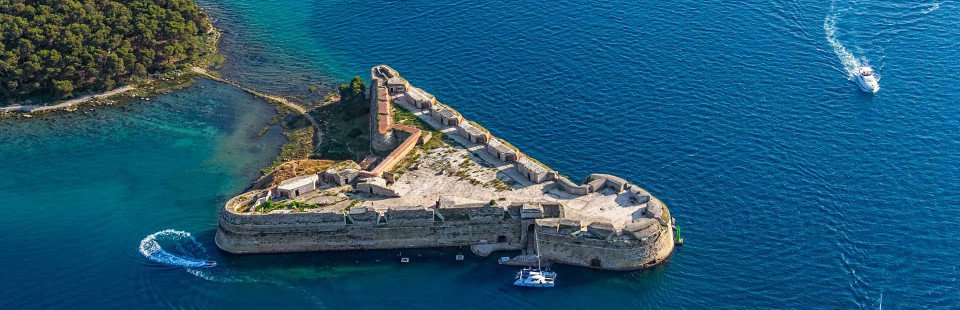
Šibenik's main monument, its Gothic-Renaissance cathedral, built of pale-gray Dalmatian stone and designated a UNESCO World Heritage Site, stands on a raised piazza close to the seafront promenade. From here a network of narrow, cobbled streets leads through the medieval quarter of tightly... Šibenik's main monument, its Gothic-Renaissance cathedral, built of pale-gray Dalmatian stone and designated a UNESCO World Heritage Site, stands on a raised piazza close to the seafront promenade. From here a network of narrow, cobbled streets leads through the medieval quarter of tightly packed, terra-cotta–roof houses, and up to the ruins of a 16th-century hilltop fortress. The city has never been a real tourist destination. Before the Croatian war for independence, it was a relatively prosperous industrial center, but when the factories closed, Šibenik sank into an economic depression. However, the cathedral more than warrants a look, and it makes a decent base for visiting the waterfalls of Krka National Park. Read More
Dubrovnik
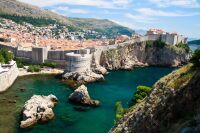
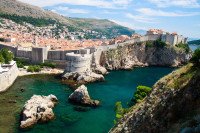
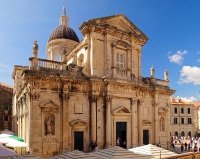
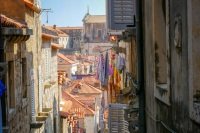
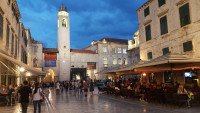
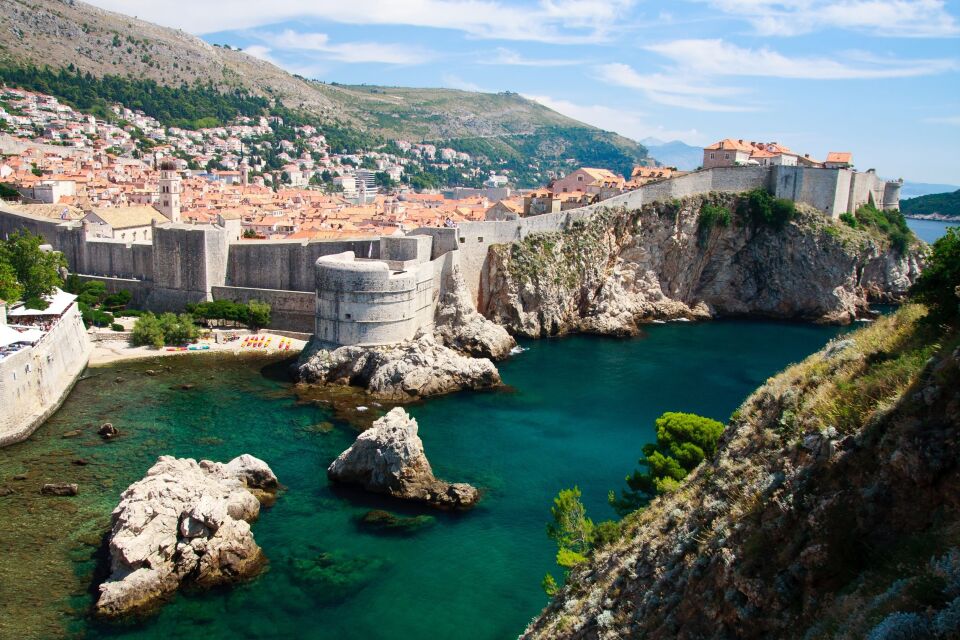
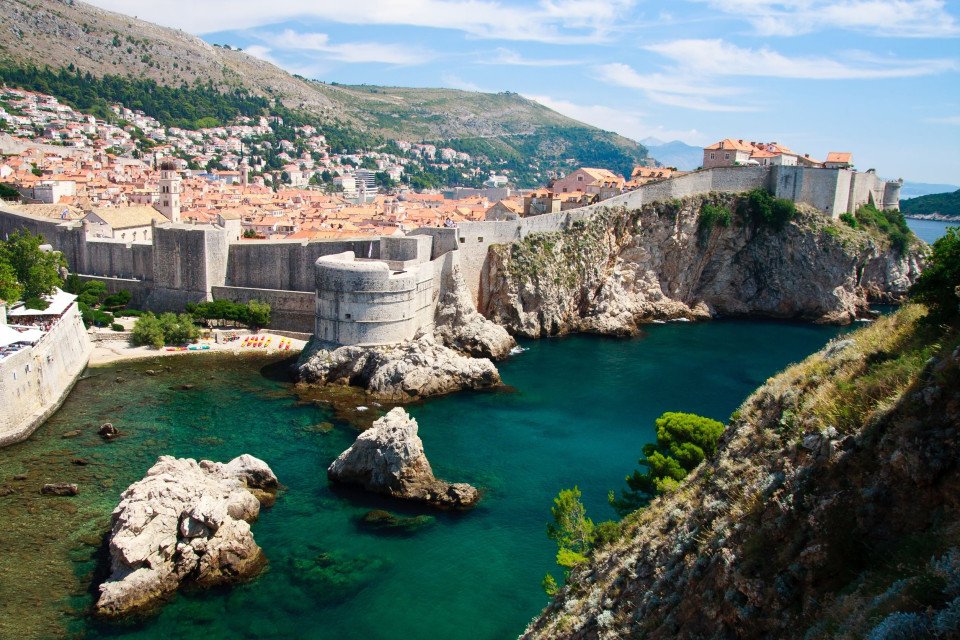
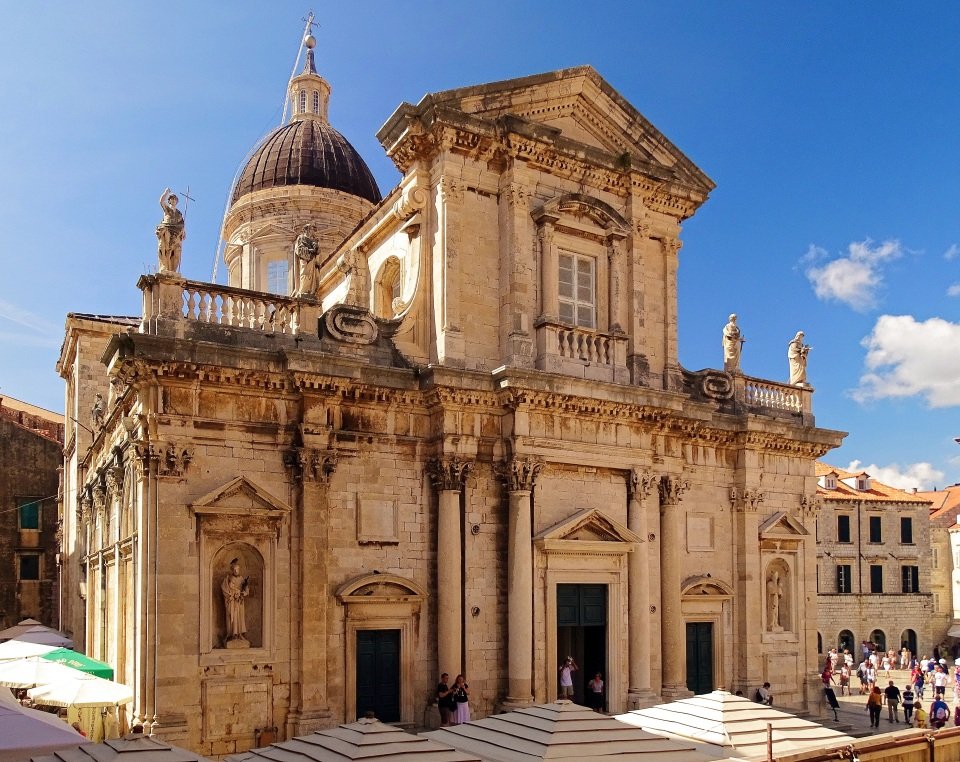
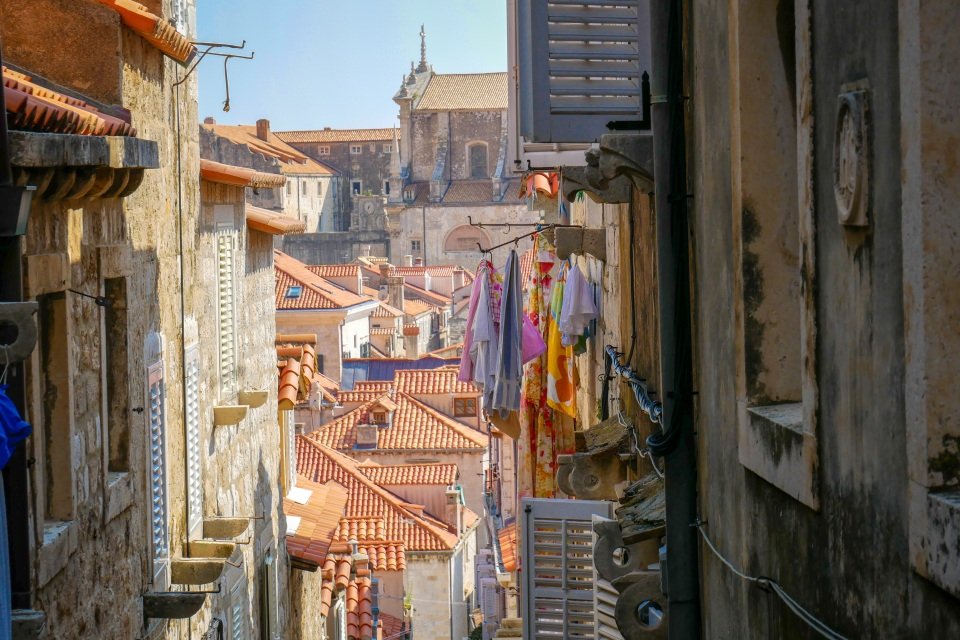
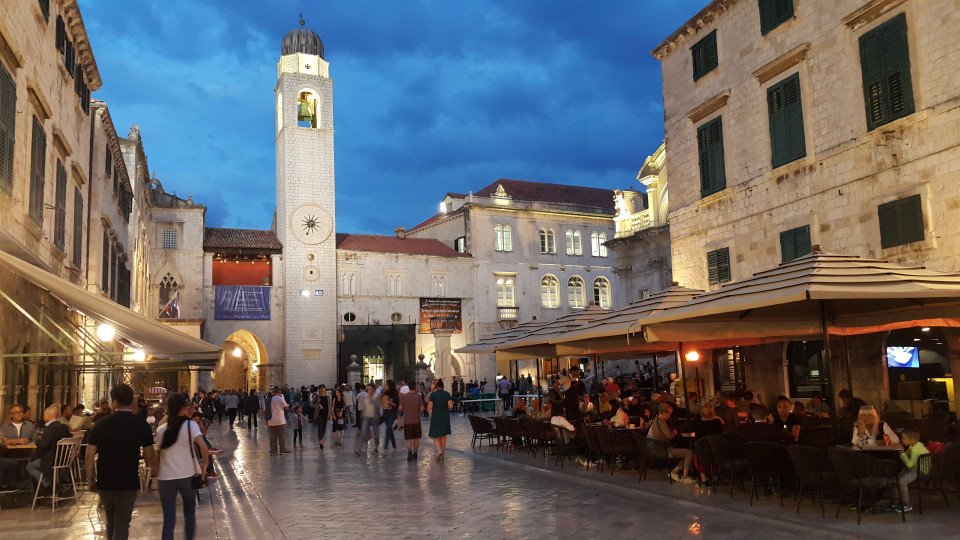
Nothing can prepare you for your first sight of Dubrovnik. Lying 216 km (135 miles) southeast of Split and commanding a jaw-dropping coastal location, it is one of the world's most beautiful fortified cities. Its massive stone ramparts and fortress towers curve around a tiny harbor, enclos... Nothing can prepare you for your first sight of Dubrovnik. Lying 216 km (135 miles) southeast of Split and commanding a jaw-dropping coastal location, it is one of the world's most beautiful fortified cities. Its massive stone ramparts and fortress towers curve around a tiny harbor, enclosing graduated ridges of sun-bleached orange-tiled roofs, copper domes, and elegant bell towers. Your imagination will run wild picturing what it looked like seven centuries ago when the walls were built, without any suburbs or highways around it, just this magnificent stone city rising out of the sea.In the 7th century AD, residents of the Roman city Epidaurum (now Cavtat) fled the Avars and Slavs of the north and founded a new settlement on a small rocky island, which they named Laus, and later Ragusa. On the mainland hillside opposite the island, the Slav settlement called Dubrovnik grew up. In the 12th century the narrow channel separating the two settlements was filled in (now the main street through the Old Town, called Stradun), and Ragusa and Dubrovnik became one. The city was surrounded by defensive walls during the 13th century, and these were reinforced with towers and bastions in the late 15th century.From 1358 to 1808 the city thrived as a powerful and remarkably sophisticated independent republic, reaching its golden age during the 16th century. In 1667 many of its splendid Gothic and Renaissance buildings were destroyed by an earthquake. The defensive walls survived the disaster, and the city was rebuilt in baroque style.Dubrovnik lost its independence to Napoléon in 1808, and in 1815 passed to Austria-Hungary. During the 20th century, as part of Yugoslavia, the city became a popular tourist destination, and in 1979 it was listed as a UNESCO World Heritage Site. During the war for independence, it came under heavy siege. Thanks to careful restoration, few traces of damage remain; however, there are maps inside the Pile and Ploče Gates illustrating the points around the city where damage was done. It’s only when you experience Dubrovnik yourself that you can understand what a treasure the world nearly lost Read More
Kotor
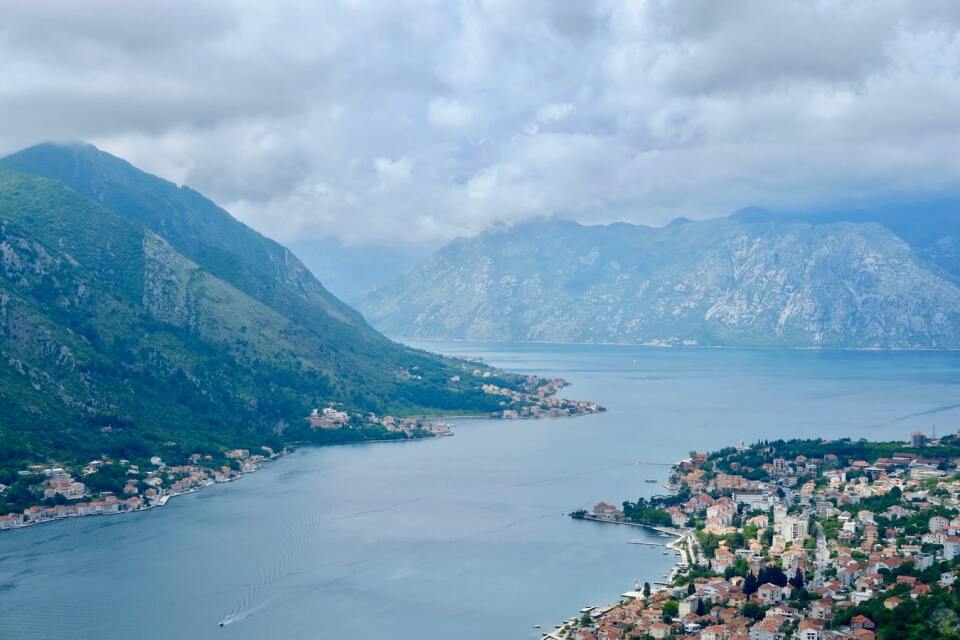
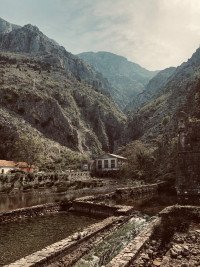
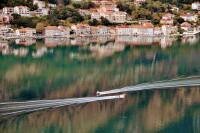
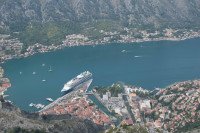
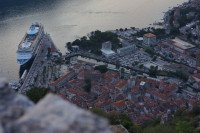
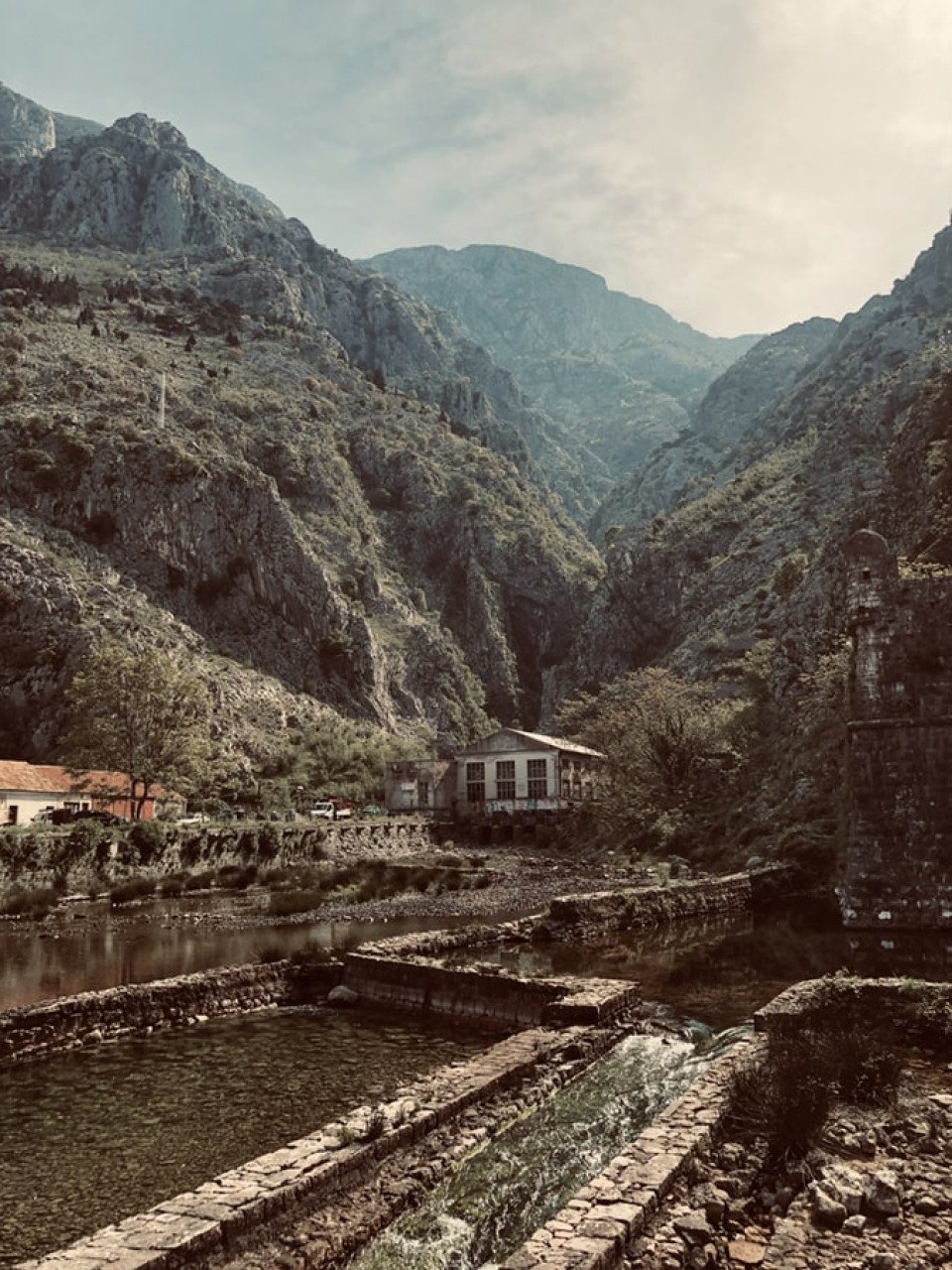
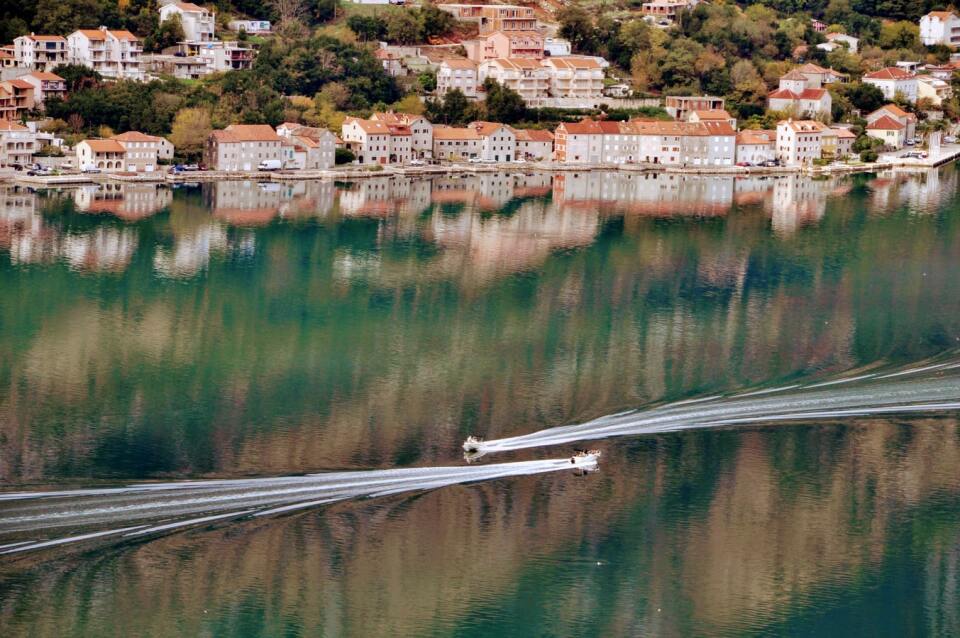
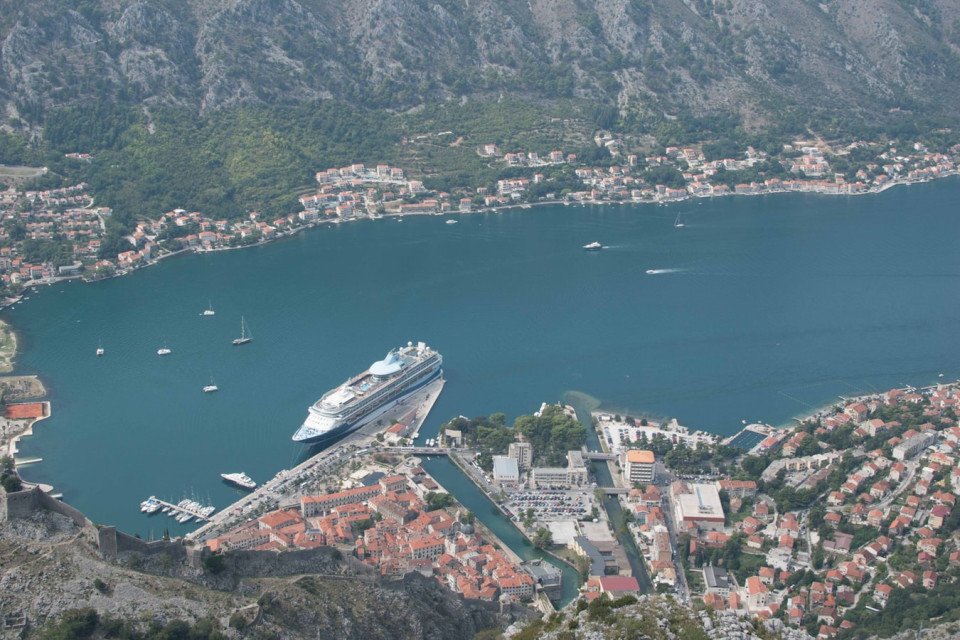
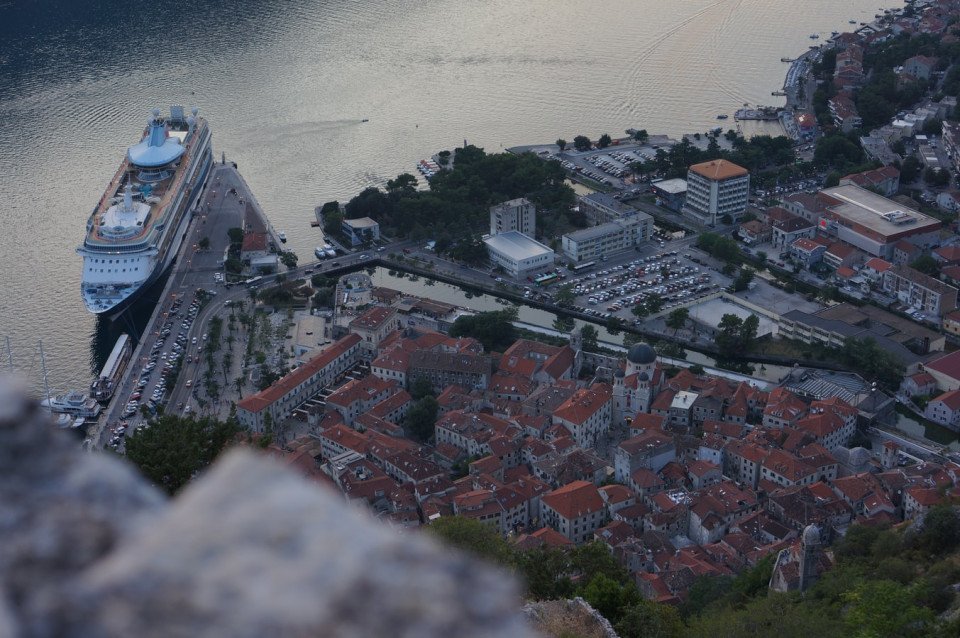
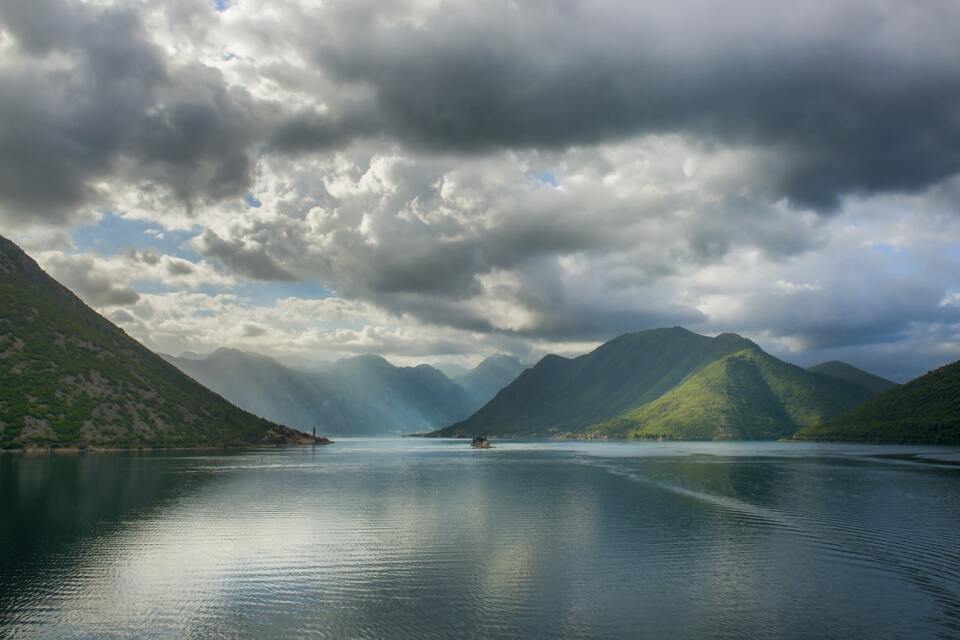
Backed by imposing mountains, tiny Kotor lies hidden from the open sea, tucked into the deepest channel of the Bokor Kotorska (Kotor Bay), which is Europe's most southerly fjord. To many, this town is more charming than its sister UNESCO World Heritage Site, Dubrovnik, retaining more authe... Backed by imposing mountains, tiny Kotor lies hidden from the open sea, tucked into the deepest channel of the Bokor Kotorska (Kotor Bay), which is Europe's most southerly fjord. To many, this town is more charming than its sister UNESCO World Heritage Site, Dubrovnik, retaining more authenticity, but with fewer tourists and spared the war damage and subsequent rebuilding which has given Dubrovnik something of a Disney feel.Kotor's medieval Stari Grad (Old Town) is enclosed within well-preserved defensive walls built between the 9th and 18th centuries and is presided over by a proud hilltop fortress. Within the walls, a labyrinth of winding cobbled streets leads through a series of splendid paved piazzas, rimmed by centuries-old stone buildings. The squares are now haunted by strains from buskers but although many now house trendy cafés and chic boutiques, directions are still given medieval-style by reference to the town’s landmark churches.In the Middle Ages, as Serbia's chief port, Kotor was an important economic and cultural center with its own highly regarded schools of stonemasonry and iconography. From 1391 to 1420 it was an independent city-republic and later, it spent periods under Venetian, Austrian, and French rule, though it was undoubtedly the Venetians who left the strongest impression on the city's architecture. Since the breakup of Yugoslavia, some 70% of the stone buildings in the romantic Old Town have been snapped up by foreigners, mostly Brits and Russians. Porto Montenegro, a new marina designed to accommodate some of the world’s largest super yachts, opened in nearby Tivat in 2011, and along the bay are other charming seaside villages, all with better views of the bay than the vista from Kotor itself where the waterside is congested with cruise ships and yachts. Try sleepy Muo or the settlement of Prčanj in one direction around the bay, or Perast and the Roman mosaics of Risan in the other direction. Read More
Piraeus
It's no wonder that all roads lead to the fascinating and maddening metropolis of Athens. Lift your eyes 200 feet above the city to the Parthenon, its honey-color marble columns rising from a massive limestone base, and you behold architectural perfection that has not been surpassed in 2,5... It's no wonder that all roads lead to the fascinating and maddening metropolis of Athens. Lift your eyes 200 feet above the city to the Parthenon, its honey-color marble columns rising from a massive limestone base, and you behold architectural perfection that has not been surpassed in 2,500 years. But, today, this shrine of classical form dominates a 21st-century boomtown. To experience Athens—Athína in Greek—fully is to understand the essence of Greece: ancient monuments surviving in a sea of cement, startling beauty amid the squalor, tradition juxtaposed with modernity. Locals depend on humor and flexibility to deal with the chaos; you should do the same. The rewards are immense. Although Athens covers a huge area, the major landmarks of the ancient Greek, Roman, and Byzantine periods are close to the modern city center. You can easily walk from the Acropolis to many other key sites, taking time to browse in shops and relax in cafés and tavernas along the way. From many quarters of the city you can glimpse "the glory that was Greece" in the form of the Acropolis looming above the horizon, but only by actually climbing that rocky precipice can you feel the impact of the ancient settlement. The Acropolis and Filopappou, two craggy hills sitting side by side; the ancient Agora (marketplace); and Kerameikos, the first cemetery, form the core of ancient and Roman Athens. Along the Unification of Archaeological Sites promenade, you can follow stone-paved, tree-lined walkways from site to site, undisturbed by traffic. Cars have also been banned or reduced in other streets in the historical center. In the National Archaeological Museum, vast numbers of artifacts illustrate the many millennia of Greek civilization; smaller museums such as the Goulandris Museum of Cycladic Art Museum and the Byzantine and Christian Museum illuminate the history of particular regions or periods. Athens may seem like one huge city, but it is really a conglomeration of neighborhoods with distinctive characters. The Eastern influences that prevailed during the 400-year rule of the Ottoman Empire are still evident in Monastiraki, the bazaar area near the foot of the Acropolis. On the northern slope of the Acropolis, stroll through Plaka (if possible by moonlight), an area of tranquil streets lined with renovated mansions, to get the flavor of the 19th-century's gracious lifestyle. The narrow lanes of Anafiotika, a section of Plaka, thread past tiny churches and small, color-washed houses with wooden upper stories, recalling a Cycladic island village. In this maze of winding streets, vestiges of the older city are everywhere: crumbling stairways lined with festive tavernas; dank cellars filled with wine vats; occasionally a court or diminutive garden, enclosed within high walls and filled with magnolia trees and the flaming trumpet-shaped flowers of hibiscus bushes. Formerly run-down old quarters, such as Thission, Gazi and Psirri, popular nightlife areas filled with bars and mezedopoleia (similar to tapas bars), are now in the process of gentrification, although they still retain much of their original charm, as does the colorful produce and meat market on Athinas. The area around Syntagma Square, the tourist hub, and Omonia Square, the commercial heart of the city about 1 km (½ mi) northwest, is distinctly European, having been designed by the court architects of King Otho, a Bavarian, in the 19th century. The chic shops and bistros of ritzy Kolonaki nestle at the foot of Mt. Lycabettus, Athens's highest hill (909 feet). Each of Athens's outlying suburbs has a distinctive character: in the north is wealthy, tree-lined Kifissia, once a summer resort for aristocratic Athenians, and in the south and southeast lie Glyfada, Voula, and Vouliagmeni, with their sandy beaches, seaside bars, and lively summer nightlife. Just beyond the city's southern fringes is Piraeus, a bustling port city of waterside fish tavernas and Saronic Gulf views. Read More
Piraeus
It's no wonder that all roads lead to the fascinating and maddening metropolis of Athens. Lift your eyes 200 feet above the city to the Parthenon, its honey-color marble columns rising from a massive limestone base, and you behold architectural perfection that has not been surpassed in 2,5... It's no wonder that all roads lead to the fascinating and maddening metropolis of Athens. Lift your eyes 200 feet above the city to the Parthenon, its honey-color marble columns rising from a massive limestone base, and you behold architectural perfection that has not been surpassed in 2,500 years. But, today, this shrine of classical form dominates a 21st-century boomtown. To experience Athens—Athína in Greek—fully is to understand the essence of Greece: ancient monuments surviving in a sea of cement, startling beauty amid the squalor, tradition juxtaposed with modernity. Locals depend on humor and flexibility to deal with the chaos; you should do the same. The rewards are immense. Although Athens covers a huge area, the major landmarks of the ancient Greek, Roman, and Byzantine periods are close to the modern city center. You can easily walk from the Acropolis to many other key sites, taking time to browse in shops and relax in cafés and tavernas along the way. From many quarters of the city you can glimpse "the glory that was Greece" in the form of the Acropolis looming above the horizon, but only by actually climbing that rocky precipice can you feel the impact of the ancient settlement. The Acropolis and Filopappou, two craggy hills sitting side by side; the ancient Agora (marketplace); and Kerameikos, the first cemetery, form the core of ancient and Roman Athens. Along the Unification of Archaeological Sites promenade, you can follow stone-paved, tree-lined walkways from site to site, undisturbed by traffic. Cars have also been banned or reduced in other streets in the historical center. In the National Archaeological Museum, vast numbers of artifacts illustrate the many millennia of Greek civilization; smaller museums such as the Goulandris Museum of Cycladic Art Museum and the Byzantine and Christian Museum illuminate the history of particular regions or periods. Athens may seem like one huge city, but it is really a conglomeration of neighborhoods with distinctive characters. The Eastern influences that prevailed during the 400-year rule of the Ottoman Empire are still evident in Monastiraki, the bazaar area near the foot of the Acropolis. On the northern slope of the Acropolis, stroll through Plaka (if possible by moonlight), an area of tranquil streets lined with renovated mansions, to get the flavor of the 19th-century's gracious lifestyle. The narrow lanes of Anafiotika, a section of Plaka, thread past tiny churches and small, color-washed houses with wooden upper stories, recalling a Cycladic island village. In this maze of winding streets, vestiges of the older city are everywhere: crumbling stairways lined with festive tavernas; dank cellars filled with wine vats; occasionally a court or diminutive garden, enclosed within high walls and filled with magnolia trees and the flaming trumpet-shaped flowers of hibiscus bushes. Formerly run-down old quarters, such as Thission, Gazi and Psirri, popular nightlife areas filled with bars and mezedopoleia (similar to tapas bars), are now in the process of gentrification, although they still retain much of their original charm, as does the colorful produce and meat market on Athinas. The area around Syntagma Square, the tourist hub, and Omonia Square, the commercial heart of the city about 1 km (½ mi) northwest, is distinctly European, having been designed by the court architects of King Otho, a Bavarian, in the 19th century. The chic shops and bistros of ritzy Kolonaki nestle at the foot of Mt. Lycabettus, Athens's highest hill (909 feet). Each of Athens's outlying suburbs has a distinctive character: in the north is wealthy, tree-lined Kifissia, once a summer resort for aristocratic Athenians, and in the south and southeast lie Glyfada, Voula, and Vouliagmeni, with their sandy beaches, seaside bars, and lively summer nightlife. Just beyond the city's southern fringes is Piraeus, a bustling port city of waterside fish tavernas and Saronic Gulf views. Read More
Bodrum
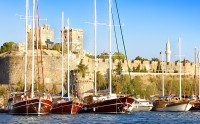
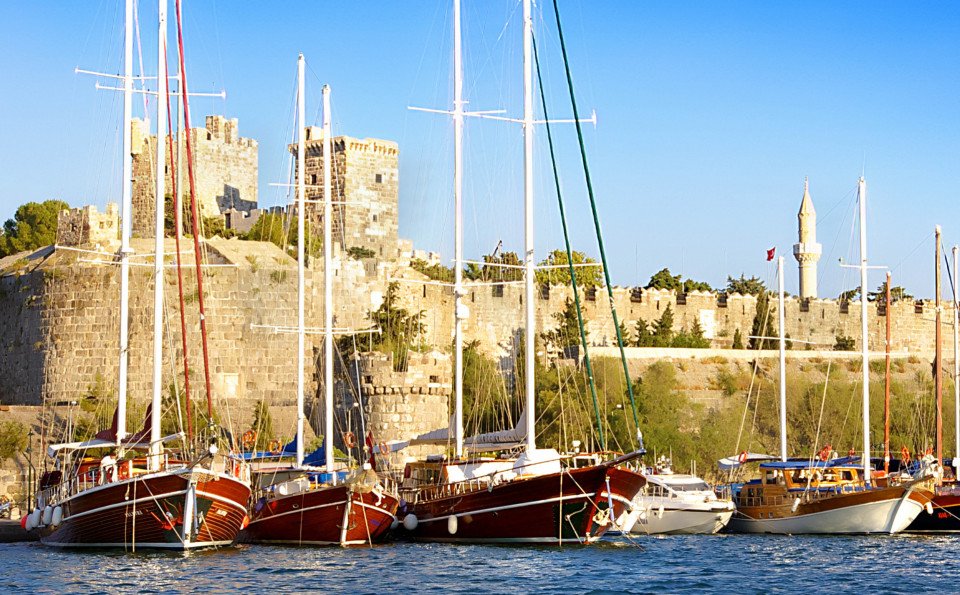
Bodrum blends ancient wonder with coastal elegance, making it a standout stop on any Aegean cruise. From its striking castle and historic ruins to stylish boutiques and sun-drenched beaches, this Turkish gem offers something for everyone. Whether you're seeking culture, relaxation, or seas... Bodrum blends ancient wonder with coastal elegance, making it a standout stop on any Aegean cruise. From its striking castle and historic ruins to stylish boutiques and sun-drenched beaches, this Turkish gem offers something for everyone. Whether you're seeking culture, relaxation, or seaside adventure, Bodrum warmly welcomes you with its charm, history, and effortless Mediterranean flair. Read More
Rhodes
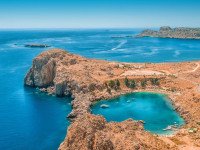
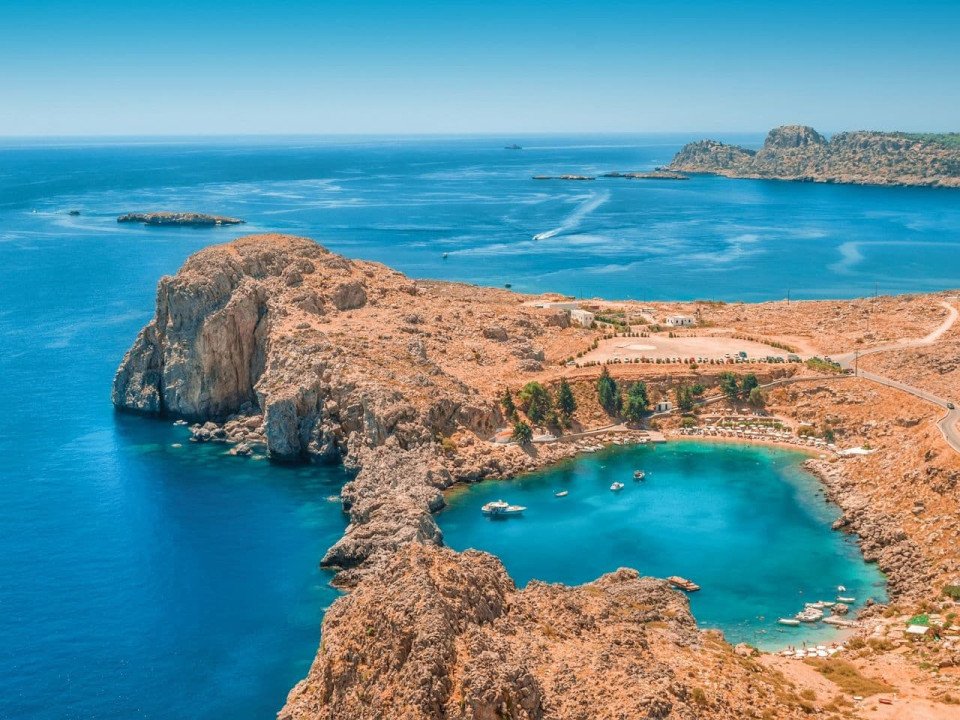
Early travelers described Rhodes as a town of two parts: a castle or high town (Collachium) and a lower city. Today Rhodes town—sometimes referred to as Ródos town—is still a city of two parts: the Old Town, a UNESCO World Heritage site that incorporates the high town and lower city, and t... Early travelers described Rhodes as a town of two parts: a castle or high town (Collachium) and a lower city. Today Rhodes town—sometimes referred to as Ródos town—is still a city of two parts: the Old Town, a UNESCO World Heritage site that incorporates the high town and lower city, and the modern metropolis, or New Town, spreading away from the walls that encircle the Old Town. The narrow streets of the Old Town are for the most part closed to cars and are lined with Orthodox and Catholic churches, Turkish houses (some of which follow the ancient orthogonal plan), and medieval public buildings with exterior staircases and facades elegantly constructed of well-cut limestone from Lindos. Careful reconstruction in recent years has enhanced the harmonious effect. Read More
Heraklion (Iraklion), Crete
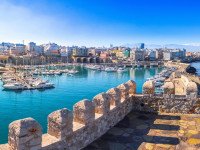
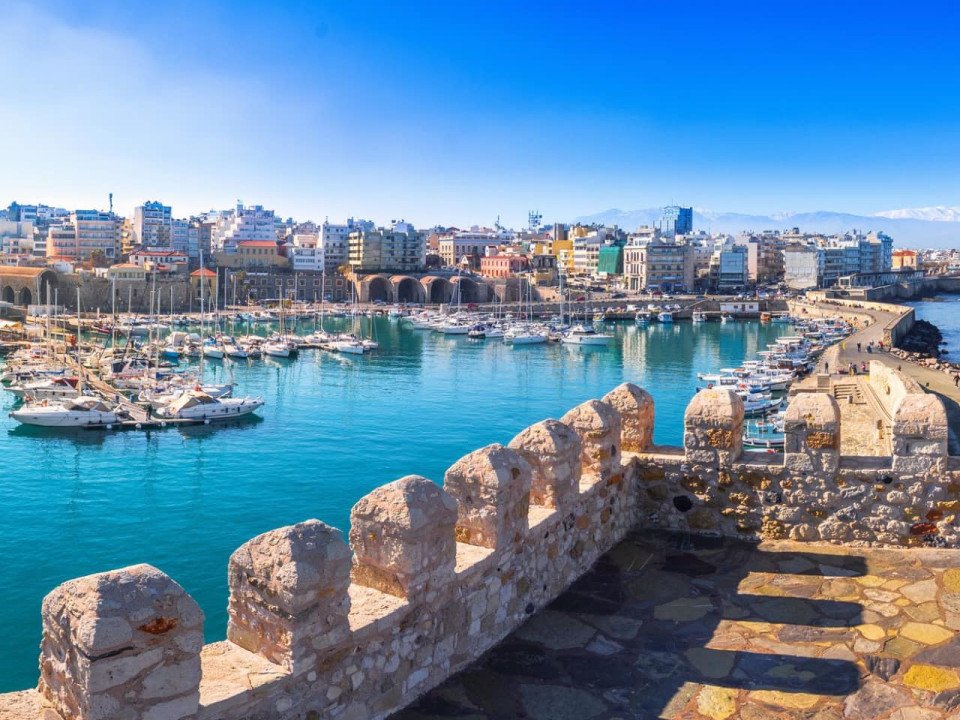
Having been controlled by Arabic, Venetian and Ottoman empires over the years - it's no surprise that Heraklion is a diverse patchwork of exotic cultures and historical treasures. Celebrated as the birthplace of the Spanish Renaissance artist, El Greco, you can visit to explore the storied... Having been controlled by Arabic, Venetian and Ottoman empires over the years - it's no surprise that Heraklion is a diverse patchwork of exotic cultures and historical treasures. Celebrated as the birthplace of the Spanish Renaissance artist, El Greco, you can visit to explore the storied ruins of the Minoan empire's capital, and unearth the rich cultural treasures that Crete’s bustling modern capital has to offer. Read More
Piraeus
It's no wonder that all roads lead to the fascinating and maddening metropolis of Athens. Lift your eyes 200 feet above the city to the Parthenon, its honey-color marble columns rising from a massive limestone base, and you behold architectural perfection that has not been surpassed in 2,5... It's no wonder that all roads lead to the fascinating and maddening metropolis of Athens. Lift your eyes 200 feet above the city to the Parthenon, its honey-color marble columns rising from a massive limestone base, and you behold architectural perfection that has not been surpassed in 2,500 years. But, today, this shrine of classical form dominates a 21st-century boomtown. To experience Athens—Athína in Greek—fully is to understand the essence of Greece: ancient monuments surviving in a sea of cement, startling beauty amid the squalor, tradition juxtaposed with modernity. Locals depend on humor and flexibility to deal with the chaos; you should do the same. The rewards are immense. Although Athens covers a huge area, the major landmarks of the ancient Greek, Roman, and Byzantine periods are close to the modern city center. You can easily walk from the Acropolis to many other key sites, taking time to browse in shops and relax in cafés and tavernas along the way. From many quarters of the city you can glimpse "the glory that was Greece" in the form of the Acropolis looming above the horizon, but only by actually climbing that rocky precipice can you feel the impact of the ancient settlement. The Acropolis and Filopappou, two craggy hills sitting side by side; the ancient Agora (marketplace); and Kerameikos, the first cemetery, form the core of ancient and Roman Athens. Along the Unification of Archaeological Sites promenade, you can follow stone-paved, tree-lined walkways from site to site, undisturbed by traffic. Cars have also been banned or reduced in other streets in the historical center. In the National Archaeological Museum, vast numbers of artifacts illustrate the many millennia of Greek civilization; smaller museums such as the Goulandris Museum of Cycladic Art Museum and the Byzantine and Christian Museum illuminate the history of particular regions or periods. Athens may seem like one huge city, but it is really a conglomeration of neighborhoods with distinctive characters. The Eastern influences that prevailed during the 400-year rule of the Ottoman Empire are still evident in Monastiraki, the bazaar area near the foot of the Acropolis. On the northern slope of the Acropolis, stroll through Plaka (if possible by moonlight), an area of tranquil streets lined with renovated mansions, to get the flavor of the 19th-century's gracious lifestyle. The narrow lanes of Anafiotika, a section of Plaka, thread past tiny churches and small, color-washed houses with wooden upper stories, recalling a Cycladic island village. In this maze of winding streets, vestiges of the older city are everywhere: crumbling stairways lined with festive tavernas; dank cellars filled with wine vats; occasionally a court or diminutive garden, enclosed within high walls and filled with magnolia trees and the flaming trumpet-shaped flowers of hibiscus bushes. Formerly run-down old quarters, such as Thission, Gazi and Psirri, popular nightlife areas filled with bars and mezedopoleia (similar to tapas bars), are now in the process of gentrification, although they still retain much of their original charm, as does the colorful produce and meat market on Athinas. The area around Syntagma Square, the tourist hub, and Omonia Square, the commercial heart of the city about 1 km (½ mi) northwest, is distinctly European, having been designed by the court architects of King Otho, a Bavarian, in the 19th century. The chic shops and bistros of ritzy Kolonaki nestle at the foot of Mt. Lycabettus, Athens's highest hill (909 feet). Each of Athens's outlying suburbs has a distinctive character: in the north is wealthy, tree-lined Kifissia, once a summer resort for aristocratic Athenians, and in the south and southeast lie Glyfada, Voula, and Vouliagmeni, with their sandy beaches, seaside bars, and lively summer nightlife. Just beyond the city's southern fringes is Piraeus, a bustling port city of waterside fish tavernas and Saronic Gulf views. Read More
Piraeus
Piraeus
Ermoupoli, Syra
Kos
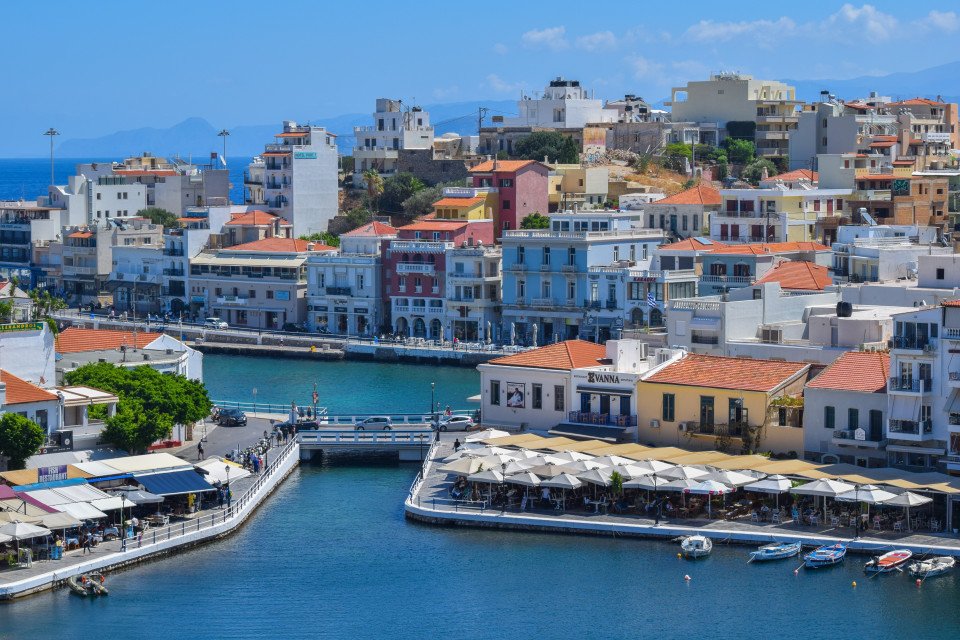
Agios Nikólaos, Kríti
Santorini
Piraeus
Piraeus
At Sea
Sarandë
At Sea
Koper
Ancona
Cruise St. Anthony Channel
Sibenik
Dubrovnik
Sailing in the Bay of Kotor
Kotor
At Sea
At Sea
Piraeus
Piraeus
At Sea
Bodrum
Rhodes
Alanya
Alanya
At Sea
Heraklion (Iraklion), Crete
Piraeus
Piraeus
Piraeus
It's no wonder that all roads lead to the fascinating and maddening metropolis of Athens. Lift your eyes 200 feet above the city to the Parthenon, its honey-color marble columns rising from a massive limestone base, and you behold architectural perfection that has not been surpassed in 2,5... It's no wonder that all roads lead to the fascinating and maddening metropolis of Athens. Lift your eyes 200 feet above the city to the Parthenon, its honey-color marble columns rising from a massive limestone base, and you behold architectural perfection that has not been surpassed in 2,500 years. But, today, this shrine of classical form dominates a 21st-century boomtown. To experience Athens—Athína in Greek—fully is to understand the essence of Greece: ancient monuments surviving in a sea of cement, startling beauty amid the squalor, tradition juxtaposed with modernity. Locals depend on humor and flexibility to deal with the chaos; you should do the same. The rewards are immense. Although Athens covers a huge area, the major landmarks of the ancient Greek, Roman, and Byzantine periods are close to the modern city center. You can easily walk from the Acropolis to many other key sites, taking time to browse in shops and relax in cafés and tavernas along the way. From many quarters of the city you can glimpse "the glory that was Greece" in the form of the Acropolis looming above the horizon, but only by actually climbing that rocky precipice can you feel the impact of the ancient settlement. The Acropolis and Filopappou, two craggy hills sitting side by side; the ancient Agora (marketplace); and Kerameikos, the first cemetery, form the core of ancient and Roman Athens. Along the Unification of Archaeological Sites promenade, you can follow stone-paved, tree-lined walkways from site to site, undisturbed by traffic. Cars have also been banned or reduced in other streets in the historical center. In the National Archaeological Museum, vast numbers of artifacts illustrate the many millennia of Greek civilization; smaller museums such as the Goulandris Museum of Cycladic Art Museum and the Byzantine and Christian Museum illuminate the history of particular regions or periods. Athens may seem like one huge city, but it is really a conglomeration of neighborhoods with distinctive characters. The Eastern influences that prevailed during the 400-year rule of the Ottoman Empire are still evident in Monastiraki, the bazaar area near the foot of the Acropolis. On the northern slope of the Acropolis, stroll through Plaka (if possible by moonlight), an area of tranquil streets lined with renovated mansions, to get the flavor of the 19th-century's gracious lifestyle. The narrow lanes of Anafiotika, a section of Plaka, thread past tiny churches and small, color-washed houses with wooden upper stories, recalling a Cycladic island village. In this maze of winding streets, vestiges of the older city are everywhere: crumbling stairways lined with festive tavernas; dank cellars filled with wine vats; occasionally a court or diminutive garden, enclosed within high walls and filled with magnolia trees and the flaming trumpet-shaped flowers of hibiscus bushes. Formerly run-down old quarters, such as Thission, Gazi and Psirri, popular nightlife areas filled with bars and mezedopoleia (similar to tapas bars), are now in the process of gentrification, although they still retain much of their original charm, as does the colorful produce and meat market on Athinas. The area around Syntagma Square, the tourist hub, and Omonia Square, the commercial heart of the city about 1 km (½ mi) northwest, is distinctly European, having been designed by the court architects of King Otho, a Bavarian, in the 19th century. The chic shops and bistros of ritzy Kolonaki nestle at the foot of Mt. Lycabettus, Athens's highest hill (909 feet). Each of Athens's outlying suburbs has a distinctive character: in the north is wealthy, tree-lined Kifissia, once a summer resort for aristocratic Athenians, and in the south and southeast lie Glyfada, Voula, and Vouliagmeni, with their sandy beaches, seaside bars, and lively summer nightlife. Just beyond the city's southern fringes is Piraeus, a bustling port city of waterside fish tavernas and Saronic Gulf views. Read More
Piraeus
Piraeus
It's no wonder that all roads lead to the fascinating and maddening metropolis of Athens. Lift your eyes 200 feet above the city to the Parthenon, its honey-color marble columns rising from a massive limestone base, and you behold architectural perfection that has not been surpassed in 2,5... It's no wonder that all roads lead to the fascinating and maddening metropolis of Athens. Lift your eyes 200 feet above the city to the Parthenon, its honey-color marble columns rising from a massive limestone base, and you behold architectural perfection that has not been surpassed in 2,500 years. But, today, this shrine of classical form dominates a 21st-century boomtown. To experience Athens—Athína in Greek—fully is to understand the essence of Greece: ancient monuments surviving in a sea of cement, startling beauty amid the squalor, tradition juxtaposed with modernity. Locals depend on humor and flexibility to deal with the chaos; you should do the same. The rewards are immense. Although Athens covers a huge area, the major landmarks of the ancient Greek, Roman, and Byzantine periods are close to the modern city center. You can easily walk from the Acropolis to many other key sites, taking time to browse in shops and relax in cafés and tavernas along the way. From many quarters of the city you can glimpse "the glory that was Greece" in the form of the Acropolis looming above the horizon, but only by actually climbing that rocky precipice can you feel the impact of the ancient settlement. The Acropolis and Filopappou, two craggy hills sitting side by side; the ancient Agora (marketplace); and Kerameikos, the first cemetery, form the core of ancient and Roman Athens. Along the Unification of Archaeological Sites promenade, you can follow stone-paved, tree-lined walkways from site to site, undisturbed by traffic. Cars have also been banned or reduced in other streets in the historical center. In the National Archaeological Museum, vast numbers of artifacts illustrate the many millennia of Greek civilization; smaller museums such as the Goulandris Museum of Cycladic Art Museum and the Byzantine and Christian Museum illuminate the history of particular regions or periods. Athens may seem like one huge city, but it is really a conglomeration of neighborhoods with distinctive characters. The Eastern influences that prevailed during the 400-year rule of the Ottoman Empire are still evident in Monastiraki, the bazaar area near the foot of the Acropolis. On the northern slope of the Acropolis, stroll through Plaka (if possible by moonlight), an area of tranquil streets lined with renovated mansions, to get the flavor of the 19th-century's gracious lifestyle. The narrow lanes of Anafiotika, a section of Plaka, thread past tiny churches and small, color-washed houses with wooden upper stories, recalling a Cycladic island village. In this maze of winding streets, vestiges of the older city are everywhere: crumbling stairways lined with festive tavernas; dank cellars filled with wine vats; occasionally a court or diminutive garden, enclosed within high walls and filled with magnolia trees and the flaming trumpet-shaped flowers of hibiscus bushes. Formerly run-down old quarters, such as Thission, Gazi and Psirri, popular nightlife areas filled with bars and mezedopoleia (similar to tapas bars), are now in the process of gentrification, although they still retain much of their original charm, as does the colorful produce and meat market on Athinas. The area around Syntagma Square, the tourist hub, and Omonia Square, the commercial heart of the city about 1 km (½ mi) northwest, is distinctly European, having been designed by the court architects of King Otho, a Bavarian, in the 19th century. The chic shops and bistros of ritzy Kolonaki nestle at the foot of Mt. Lycabettus, Athens's highest hill (909 feet). Each of Athens's outlying suburbs has a distinctive character: in the north is wealthy, tree-lined Kifissia, once a summer resort for aristocratic Athenians, and in the south and southeast lie Glyfada, Voula, and Vouliagmeni, with their sandy beaches, seaside bars, and lively summer nightlife. Just beyond the city's southern fringes is Piraeus, a bustling port city of waterside fish tavernas and Saronic Gulf views. Read More
Ermoupoli, Syra
Ermoupoli, Syra
Syros is an island in the Aegean Sea, 78 miles (125 kilometres) southeast of Athens, and the administrative, commercial, intellectual and cultural centre of the Cyclades. Syros is 32 square miles (82.8 square kilometres) in area. Its largest towns are Ermoupoli, the capital of the island a... Syros is an island in the Aegean Sea, 78 miles (125 kilometres) southeast of Athens, and the administrative, commercial, intellectual and cultural centre of the Cyclades. Syros is 32 square miles (82.8 square kilometres) in area. Its largest towns are Ermoupoli, the capital of the island and Cyclades, Ano Syros and Vari. Although Syros belongs to the Cyclades islands, its architecture is more medieval than Cycladic. The beaches of Syros are especially inviting, and surrounded by many tourist facilities and accommodations. Read More
Kos
Agios Nikólaos, Kríti
Santorini
Santorini
Undoubtedly the most extraordinary island in the Aegean, crescent-shape Santorini remains a mandatory stop on the Cycladic tourist route—even if it's necessary to enjoy the sensational sunsets from Ia, the fascinating excavations, and the dazzling white towns with a million other travelers... Undoubtedly the most extraordinary island in the Aegean, crescent-shape Santorini remains a mandatory stop on the Cycladic tourist route—even if it's necessary to enjoy the sensational sunsets from Ia, the fascinating excavations, and the dazzling white towns with a million other travelers. Called Kállisti (the "Loveliest") when first settled, the island has now reverted to its subsequent name of Thira, after the 9th-century-BC Dorian colonizer Thiras. The place is better known, however, these days as Santorini, a name derived from its patroness, St. Irene of Thessaloniki, the Byzantine empress who restored icons to Orthodoxy and died in 802. You can fly conveniently to Santorini, but to enjoy a true Santorini rite of passage, opt instead for the boat trip here, which provides a spectacular introduction. After the boat sails between Sikinos and Ios, your deck-side perch approaches two close islands with a passage between them. The bigger one on the left is Santorini, and the smaller on the right is Thirassia. Passing between them, you see the village of Ia adorning Santorini's northernmost cliff like a white geometric beehive. You are in the caldera (volcanic crater), one of the world's truly breathtaking sights: a demilune of cliffs rising 1,100 feet, with the white clusters of the towns of Fira and Ia perched along the top. The bay, once the high center of the island, is 1,300 feet in some places, so deep that when boats dock in Santorini's shabby little port of Athinios, they do not drop anchor. The encircling cliffs are the ancient rim of a still-active volcano, and you are sailing east across its flooded caldera. On your right are the Burnt isles, the White isle, and other volcanic remnants, all lined up as if some outsize display in a geology museum. Hephaestus's subterranean fires smolder still—the volcano erupted in 198 BC, about 735, and there was an earthquake in 1956. Indeed, Santorini and its four neighboring islets are the fragmentary remains of a larger landmass that exploded about 1600 BC: the volcano's core blew sky high, and the sea rushed into the abyss to create the great bay, which measures 10 km by 7 km (6 mi by 4½ mi) and is 1,292 feet deep. The other pieces of the rim, which broke off in later eruptions, are Thirassia, where a few hundred people live, and deserted little Aspronissi ("White isle"). In the center of the bay, black and uninhabited, two cones, the Burnt Isles of Palea Kameni and Nea Kameni, appeared between 1573 and 1925. There has been too much speculation about the identification of Santorini with the mythical Atlantis, mentioned in Egyptian papyri and by Plato (who says it's in the Atlantic), but myths are hard to pin down. This is not true of old arguments about whether tidal waves from Santorini's cataclysmic explosion destroyed Minoan civilization on Crete, 113 km (70 mi) away. The latest carbon-dating evidence, which points to a few years before 1600 BC for the eruption, clearly indicates that the Minoans outlasted the eruption by a couple of hundred years, but most probably in a weakened state. In fact, the island still endures hardships: since antiquity, Santorini has depended on rain collected in cisterns for drinking and irrigating—the well water is often brackish—and the serious shortage is alleviated by the importation of water. However, the volcanic soil also yields riches: small, intense tomatoes with tough skins used for tomato paste (good restaurants here serve them); the famous Santorini fava beans, which have a light, fresh taste; barley; wheat; and white-skin eggplants. Read More
Piraeus
Piraeus
It's no wonder that all roads lead to the fascinating and maddening metropolis of Athens. Lift your eyes 200 feet above the city to the Parthenon, its honey-color marble columns rising from a massive limestone base, and you behold architectural perfection that has not been surpassed in 2,5... It's no wonder that all roads lead to the fascinating and maddening metropolis of Athens. Lift your eyes 200 feet above the city to the Parthenon, its honey-color marble columns rising from a massive limestone base, and you behold architectural perfection that has not been surpassed in 2,500 years. But, today, this shrine of classical form dominates a 21st-century boomtown. To experience Athens—Athína in Greek—fully is to understand the essence of Greece: ancient monuments surviving in a sea of cement, startling beauty amid the squalor, tradition juxtaposed with modernity. Locals depend on humor and flexibility to deal with the chaos; you should do the same. The rewards are immense. Although Athens covers a huge area, the major landmarks of the ancient Greek, Roman, and Byzantine periods are close to the modern city center. You can easily walk from the Acropolis to many other key sites, taking time to browse in shops and relax in cafés and tavernas along the way. From many quarters of the city you can glimpse "the glory that was Greece" in the form of the Acropolis looming above the horizon, but only by actually climbing that rocky precipice can you feel the impact of the ancient settlement. The Acropolis and Filopappou, two craggy hills sitting side by side; the ancient Agora (marketplace); and Kerameikos, the first cemetery, form the core of ancient and Roman Athens. Along the Unification of Archaeological Sites promenade, you can follow stone-paved, tree-lined walkways from site to site, undisturbed by traffic. Cars have also been banned or reduced in other streets in the historical center. In the National Archaeological Museum, vast numbers of artifacts illustrate the many millennia of Greek civilization; smaller museums such as the Goulandris Museum of Cycladic Art Museum and the Byzantine and Christian Museum illuminate the history of particular regions or periods. Athens may seem like one huge city, but it is really a conglomeration of neighborhoods with distinctive characters. The Eastern influences that prevailed during the 400-year rule of the Ottoman Empire are still evident in Monastiraki, the bazaar area near the foot of the Acropolis. On the northern slope of the Acropolis, stroll through Plaka (if possible by moonlight), an area of tranquil streets lined with renovated mansions, to get the flavor of the 19th-century's gracious lifestyle. The narrow lanes of Anafiotika, a section of Plaka, thread past tiny churches and small, color-washed houses with wooden upper stories, recalling a Cycladic island village. In this maze of winding streets, vestiges of the older city are everywhere: crumbling stairways lined with festive tavernas; dank cellars filled with wine vats; occasionally a court or diminutive garden, enclosed within high walls and filled with magnolia trees and the flaming trumpet-shaped flowers of hibiscus bushes. Formerly run-down old quarters, such as Thission, Gazi and Psirri, popular nightlife areas filled with bars and mezedopoleia (similar to tapas bars), are now in the process of gentrification, although they still retain much of their original charm, as does the colorful produce and meat market on Athinas. The area around Syntagma Square, the tourist hub, and Omonia Square, the commercial heart of the city about 1 km (½ mi) northwest, is distinctly European, having been designed by the court architects of King Otho, a Bavarian, in the 19th century. The chic shops and bistros of ritzy Kolonaki nestle at the foot of Mt. Lycabettus, Athens's highest hill (909 feet). Each of Athens's outlying suburbs has a distinctive character: in the north is wealthy, tree-lined Kifissia, once a summer resort for aristocratic Athenians, and in the south and southeast lie Glyfada, Voula, and Vouliagmeni, with their sandy beaches, seaside bars, and lively summer nightlife. Just beyond the city's southern fringes is Piraeus, a bustling port city of waterside fish tavernas and Saronic Gulf views. Read More
Piraeus
Piraeus
It's no wonder that all roads lead to the fascinating and maddening metropolis of Athens. Lift your eyes 200 feet above the city to the Parthenon, its honey-color marble columns rising from a massive limestone base, and you behold architectural perfection that has not been surpassed in 2,5... It's no wonder that all roads lead to the fascinating and maddening metropolis of Athens. Lift your eyes 200 feet above the city to the Parthenon, its honey-color marble columns rising from a massive limestone base, and you behold architectural perfection that has not been surpassed in 2,500 years. But, today, this shrine of classical form dominates a 21st-century boomtown. To experience Athens—Athína in Greek—fully is to understand the essence of Greece: ancient monuments surviving in a sea of cement, startling beauty amid the squalor, tradition juxtaposed with modernity. Locals depend on humor and flexibility to deal with the chaos; you should do the same. The rewards are immense. Although Athens covers a huge area, the major landmarks of the ancient Greek, Roman, and Byzantine periods are close to the modern city center. You can easily walk from the Acropolis to many other key sites, taking time to browse in shops and relax in cafés and tavernas along the way. From many quarters of the city you can glimpse "the glory that was Greece" in the form of the Acropolis looming above the horizon, but only by actually climbing that rocky precipice can you feel the impact of the ancient settlement. The Acropolis and Filopappou, two craggy hills sitting side by side; the ancient Agora (marketplace); and Kerameikos, the first cemetery, form the core of ancient and Roman Athens. Along the Unification of Archaeological Sites promenade, you can follow stone-paved, tree-lined walkways from site to site, undisturbed by traffic. Cars have also been banned or reduced in other streets in the historical center. In the National Archaeological Museum, vast numbers of artifacts illustrate the many millennia of Greek civilization; smaller museums such as the Goulandris Museum of Cycladic Art Museum and the Byzantine and Christian Museum illuminate the history of particular regions or periods. Athens may seem like one huge city, but it is really a conglomeration of neighborhoods with distinctive characters. The Eastern influences that prevailed during the 400-year rule of the Ottoman Empire are still evident in Monastiraki, the bazaar area near the foot of the Acropolis. On the northern slope of the Acropolis, stroll through Plaka (if possible by moonlight), an area of tranquil streets lined with renovated mansions, to get the flavor of the 19th-century's gracious lifestyle. The narrow lanes of Anafiotika, a section of Plaka, thread past tiny churches and small, color-washed houses with wooden upper stories, recalling a Cycladic island village. In this maze of winding streets, vestiges of the older city are everywhere: crumbling stairways lined with festive tavernas; dank cellars filled with wine vats; occasionally a court or diminutive garden, enclosed within high walls and filled with magnolia trees and the flaming trumpet-shaped flowers of hibiscus bushes. Formerly run-down old quarters, such as Thission, Gazi and Psirri, popular nightlife areas filled with bars and mezedopoleia (similar to tapas bars), are now in the process of gentrification, although they still retain much of their original charm, as does the colorful produce and meat market on Athinas. The area around Syntagma Square, the tourist hub, and Omonia Square, the commercial heart of the city about 1 km (½ mi) northwest, is distinctly European, having been designed by the court architects of King Otho, a Bavarian, in the 19th century. The chic shops and bistros of ritzy Kolonaki nestle at the foot of Mt. Lycabettus, Athens's highest hill (909 feet). Each of Athens's outlying suburbs has a distinctive character: in the north is wealthy, tree-lined Kifissia, once a summer resort for aristocratic Athenians, and in the south and southeast lie Glyfada, Voula, and Vouliagmeni, with their sandy beaches, seaside bars, and lively summer nightlife. Just beyond the city's southern fringes is Piraeus, a bustling port city of waterside fish tavernas and Saronic Gulf views. Read More
At Sea
Sarandë
Sarandë
Sarandë is a city in southern Albania on the coast of the Ionian Sea. Sarandë can be reached easily from the Greek island of Corfu by ferry. An early Christian monastery dedicated to 40 saints (Santi Quaranta) gave Sarandë its name. The city center of Sarandë has been scarred by communist... Sarandë is a city in southern Albania on the coast of the Ionian Sea. Sarandë can be reached easily from the Greek island of Corfu by ferry. An early Christian monastery dedicated to 40 saints (Santi Quaranta) gave Sarandë its name. The city center of Sarandë has been scarred by communist architecture but since the fall of communism many small shops and bars have sprung up which give it a Mediterranean feel. This southernmost harbour of Albania was once the ancient port of Onchesmos. Today, Sarandë’s main attractions are its sunny climate and the nearby ruins of Butrint. Please Note: For your convenience, shore excursions offered for this port of call are available to reserve in advance at www.silversea.com, unless otherwise noted in the description. The deadline to reserve these tours is August 19, after which they will be available for purchase on board, unless otherwise noted in the description. Pier Information The ship is scheduled to anchor at Main Pier. The town center is 875 yards from the pier. Taxis are generally available at the pier. Shopping Typical souvenirs include t-shirts, postcards, wood carvings and dolls in national costume. Cuisine Albanian cuisine has been strongly influenced by Turkey. Grilled meats like shisqubap (shish kebab), romstek (minced meat patties) and gofte (meat balls) are served all across the Balkans. Some local dishes include comlek (meat and onion stew), fërges (a rich beef stew), rosto me salcë kosi (roast beef with sour cream) and tavë kosi (mutton with yoghurt. Lake Shkodra carp and Lake Ohrid trout are the most common fish dishes. Try the ice cream (akullore), which is popular everywhere. Other Sites Blue Eye Spring The iridescent blue water gushes from the depths of the earth and feeds the Bistrica River. Catacombs Recently discovered catacombs of the church of the Forty Saints can also be explored. Private arrangements for independent sightseeing may be requested through the Tour Office on board. Read More
At Sea
Koper
Koper
Today a port town surrounded by industrial suburbs, Koper nevertheless warrants a visit. The Republic of Venice made Koper the regional capital during the 15th and 16th centuries, and the magnificent architecture of the Old Town bears witness to the spirit of those times.The most important... Today a port town surrounded by industrial suburbs, Koper nevertheless warrants a visit. The Republic of Venice made Koper the regional capital during the 15th and 16th centuries, and the magnificent architecture of the Old Town bears witness to the spirit of those times.The most important buildings are clustered around Titov trg, the central town square. Here stands the Cathedral, which can be visited daily from 7 to noon and 3 to 7, with its fine Venetian Gothic facade and bell tower dating back to 1664. Across the square the splendid Praetor's Palace, formerly the seat of the Venetian Grand Council, combines Gothic and Renaissance styles. From the west side of Titov trg, the narrow, cobbled Kidriceva ulica brings you down to the seafront. Read More
Ancona
Ancona
Ancona is the capital of Italy's Marche region. Ancona's main attraction is her tactile museum for the blinds. It's also a great place to take a dip and enjoy great sea views under the sunshine.
Cruise St. Anthony Channel
Sibenik
Sibenik
Šibenik's main monument, its Gothic-Renaissance cathedral, built of pale-gray Dalmatian stone and designated a UNESCO World Heritage Site, stands on a raised piazza close to the seafront promenade. From here a network of narrow, cobbled streets leads through the medieval quarter of tightly... Šibenik's main monument, its Gothic-Renaissance cathedral, built of pale-gray Dalmatian stone and designated a UNESCO World Heritage Site, stands on a raised piazza close to the seafront promenade. From here a network of narrow, cobbled streets leads through the medieval quarter of tightly packed, terra-cotta–roof houses, and up to the ruins of a 16th-century hilltop fortress. The city has never been a real tourist destination. Before the Croatian war for independence, it was a relatively prosperous industrial center, but when the factories closed, Šibenik sank into an economic depression. However, the cathedral more than warrants a look, and it makes a decent base for visiting the waterfalls of Krka National Park. Read More
Dubrovnik
Dubrovnik
Nothing can prepare you for your first sight of Dubrovnik. Lying 216 km (135 miles) southeast of Split and commanding a jaw-dropping coastal location, it is one of the world's most beautiful fortified cities. Its massive stone ramparts and fortress towers curve around a tiny harbor, enclos... Nothing can prepare you for your first sight of Dubrovnik. Lying 216 km (135 miles) southeast of Split and commanding a jaw-dropping coastal location, it is one of the world's most beautiful fortified cities. Its massive stone ramparts and fortress towers curve around a tiny harbor, enclosing graduated ridges of sun-bleached orange-tiled roofs, copper domes, and elegant bell towers. Your imagination will run wild picturing what it looked like seven centuries ago when the walls were built, without any suburbs or highways around it, just this magnificent stone city rising out of the sea.In the 7th century AD, residents of the Roman city Epidaurum (now Cavtat) fled the Avars and Slavs of the north and founded a new settlement on a small rocky island, which they named Laus, and later Ragusa. On the mainland hillside opposite the island, the Slav settlement called Dubrovnik grew up. In the 12th century the narrow channel separating the two settlements was filled in (now the main street through the Old Town, called Stradun), and Ragusa and Dubrovnik became one. The city was surrounded by defensive walls during the 13th century, and these were reinforced with towers and bastions in the late 15th century.From 1358 to 1808 the city thrived as a powerful and remarkably sophisticated independent republic, reaching its golden age during the 16th century. In 1667 many of its splendid Gothic and Renaissance buildings were destroyed by an earthquake. The defensive walls survived the disaster, and the city was rebuilt in baroque style.Dubrovnik lost its independence to Napoléon in 1808, and in 1815 passed to Austria-Hungary. During the 20th century, as part of Yugoslavia, the city became a popular tourist destination, and in 1979 it was listed as a UNESCO World Heritage Site. During the war for independence, it came under heavy siege. Thanks to careful restoration, few traces of damage remain; however, there are maps inside the Pile and Ploče Gates illustrating the points around the city where damage was done. It’s only when you experience Dubrovnik yourself that you can understand what a treasure the world nearly lost Read More
Sailing in the Bay of Kotor
Kotor
Kotor
Backed by imposing mountains, tiny Kotor lies hidden from the open sea, tucked into the deepest channel of the Bokor Kotorska (Kotor Bay), which is Europe's most southerly fjord. To many, this town is more charming than its sister UNESCO World Heritage Site, Dubrovnik, retaining more authe... Backed by imposing mountains, tiny Kotor lies hidden from the open sea, tucked into the deepest channel of the Bokor Kotorska (Kotor Bay), which is Europe's most southerly fjord. To many, this town is more charming than its sister UNESCO World Heritage Site, Dubrovnik, retaining more authenticity, but with fewer tourists and spared the war damage and subsequent rebuilding which has given Dubrovnik something of a Disney feel.Kotor's medieval Stari Grad (Old Town) is enclosed within well-preserved defensive walls built between the 9th and 18th centuries and is presided over by a proud hilltop fortress. Within the walls, a labyrinth of winding cobbled streets leads through a series of splendid paved piazzas, rimmed by centuries-old stone buildings. The squares are now haunted by strains from buskers but although many now house trendy cafés and chic boutiques, directions are still given medieval-style by reference to the town’s landmark churches.In the Middle Ages, as Serbia's chief port, Kotor was an important economic and cultural center with its own highly regarded schools of stonemasonry and iconography. From 1391 to 1420 it was an independent city-republic and later, it spent periods under Venetian, Austrian, and French rule, though it was undoubtedly the Venetians who left the strongest impression on the city's architecture. Since the breakup of Yugoslavia, some 70% of the stone buildings in the romantic Old Town have been snapped up by foreigners, mostly Brits and Russians. Porto Montenegro, a new marina designed to accommodate some of the world’s largest super yachts, opened in nearby Tivat in 2011, and along the bay are other charming seaside villages, all with better views of the bay than the vista from Kotor itself where the waterside is congested with cruise ships and yachts. Try sleepy Muo or the settlement of Prčanj in one direction around the bay, or Perast and the Roman mosaics of Risan in the other direction. Read More
At Sea
At Sea
Piraeus
Piraeus
It's no wonder that all roads lead to the fascinating and maddening metropolis of Athens. Lift your eyes 200 feet above the city to the Parthenon, its honey-color marble columns rising from a massive limestone base, and you behold architectural perfection that has not been surpassed in 2,5... It's no wonder that all roads lead to the fascinating and maddening metropolis of Athens. Lift your eyes 200 feet above the city to the Parthenon, its honey-color marble columns rising from a massive limestone base, and you behold architectural perfection that has not been surpassed in 2,500 years. But, today, this shrine of classical form dominates a 21st-century boomtown. To experience Athens—Athína in Greek—fully is to understand the essence of Greece: ancient monuments surviving in a sea of cement, startling beauty amid the squalor, tradition juxtaposed with modernity. Locals depend on humor and flexibility to deal with the chaos; you should do the same. The rewards are immense. Although Athens covers a huge area, the major landmarks of the ancient Greek, Roman, and Byzantine periods are close to the modern city center. You can easily walk from the Acropolis to many other key sites, taking time to browse in shops and relax in cafés and tavernas along the way. From many quarters of the city you can glimpse "the glory that was Greece" in the form of the Acropolis looming above the horizon, but only by actually climbing that rocky precipice can you feel the impact of the ancient settlement. The Acropolis and Filopappou, two craggy hills sitting side by side; the ancient Agora (marketplace); and Kerameikos, the first cemetery, form the core of ancient and Roman Athens. Along the Unification of Archaeological Sites promenade, you can follow stone-paved, tree-lined walkways from site to site, undisturbed by traffic. Cars have also been banned or reduced in other streets in the historical center. In the National Archaeological Museum, vast numbers of artifacts illustrate the many millennia of Greek civilization; smaller museums such as the Goulandris Museum of Cycladic Art Museum and the Byzantine and Christian Museum illuminate the history of particular regions or periods. Athens may seem like one huge city, but it is really a conglomeration of neighborhoods with distinctive characters. The Eastern influences that prevailed during the 400-year rule of the Ottoman Empire are still evident in Monastiraki, the bazaar area near the foot of the Acropolis. On the northern slope of the Acropolis, stroll through Plaka (if possible by moonlight), an area of tranquil streets lined with renovated mansions, to get the flavor of the 19th-century's gracious lifestyle. The narrow lanes of Anafiotika, a section of Plaka, thread past tiny churches and small, color-washed houses with wooden upper stories, recalling a Cycladic island village. In this maze of winding streets, vestiges of the older city are everywhere: crumbling stairways lined with festive tavernas; dank cellars filled with wine vats; occasionally a court or diminutive garden, enclosed within high walls and filled with magnolia trees and the flaming trumpet-shaped flowers of hibiscus bushes. Formerly run-down old quarters, such as Thission, Gazi and Psirri, popular nightlife areas filled with bars and mezedopoleia (similar to tapas bars), are now in the process of gentrification, although they still retain much of their original charm, as does the colorful produce and meat market on Athinas. The area around Syntagma Square, the tourist hub, and Omonia Square, the commercial heart of the city about 1 km (½ mi) northwest, is distinctly European, having been designed by the court architects of King Otho, a Bavarian, in the 19th century. The chic shops and bistros of ritzy Kolonaki nestle at the foot of Mt. Lycabettus, Athens's highest hill (909 feet). Each of Athens's outlying suburbs has a distinctive character: in the north is wealthy, tree-lined Kifissia, once a summer resort for aristocratic Athenians, and in the south and southeast lie Glyfada, Voula, and Vouliagmeni, with their sandy beaches, seaside bars, and lively summer nightlife. Just beyond the city's southern fringes is Piraeus, a bustling port city of waterside fish tavernas and Saronic Gulf views. Read More
Piraeus
Piraeus
It's no wonder that all roads lead to the fascinating and maddening metropolis of Athens. Lift your eyes 200 feet above the city to the Parthenon, its honey-color marble columns rising from a massive limestone base, and you behold architectural perfection that has not been surpassed in 2,5... It's no wonder that all roads lead to the fascinating and maddening metropolis of Athens. Lift your eyes 200 feet above the city to the Parthenon, its honey-color marble columns rising from a massive limestone base, and you behold architectural perfection that has not been surpassed in 2,500 years. But, today, this shrine of classical form dominates a 21st-century boomtown. To experience Athens—Athína in Greek—fully is to understand the essence of Greece: ancient monuments surviving in a sea of cement, startling beauty amid the squalor, tradition juxtaposed with modernity. Locals depend on humor and flexibility to deal with the chaos; you should do the same. The rewards are immense. Although Athens covers a huge area, the major landmarks of the ancient Greek, Roman, and Byzantine periods are close to the modern city center. You can easily walk from the Acropolis to many other key sites, taking time to browse in shops and relax in cafés and tavernas along the way. From many quarters of the city you can glimpse "the glory that was Greece" in the form of the Acropolis looming above the horizon, but only by actually climbing that rocky precipice can you feel the impact of the ancient settlement. The Acropolis and Filopappou, two craggy hills sitting side by side; the ancient Agora (marketplace); and Kerameikos, the first cemetery, form the core of ancient and Roman Athens. Along the Unification of Archaeological Sites promenade, you can follow stone-paved, tree-lined walkways from site to site, undisturbed by traffic. Cars have also been banned or reduced in other streets in the historical center. In the National Archaeological Museum, vast numbers of artifacts illustrate the many millennia of Greek civilization; smaller museums such as the Goulandris Museum of Cycladic Art Museum and the Byzantine and Christian Museum illuminate the history of particular regions or periods. Athens may seem like one huge city, but it is really a conglomeration of neighborhoods with distinctive characters. The Eastern influences that prevailed during the 400-year rule of the Ottoman Empire are still evident in Monastiraki, the bazaar area near the foot of the Acropolis. On the northern slope of the Acropolis, stroll through Plaka (if possible by moonlight), an area of tranquil streets lined with renovated mansions, to get the flavor of the 19th-century's gracious lifestyle. The narrow lanes of Anafiotika, a section of Plaka, thread past tiny churches and small, color-washed houses with wooden upper stories, recalling a Cycladic island village. In this maze of winding streets, vestiges of the older city are everywhere: crumbling stairways lined with festive tavernas; dank cellars filled with wine vats; occasionally a court or diminutive garden, enclosed within high walls and filled with magnolia trees and the flaming trumpet-shaped flowers of hibiscus bushes. Formerly run-down old quarters, such as Thission, Gazi and Psirri, popular nightlife areas filled with bars and mezedopoleia (similar to tapas bars), are now in the process of gentrification, although they still retain much of their original charm, as does the colorful produce and meat market on Athinas. The area around Syntagma Square, the tourist hub, and Omonia Square, the commercial heart of the city about 1 km (½ mi) northwest, is distinctly European, having been designed by the court architects of King Otho, a Bavarian, in the 19th century. The chic shops and bistros of ritzy Kolonaki nestle at the foot of Mt. Lycabettus, Athens's highest hill (909 feet). Each of Athens's outlying suburbs has a distinctive character: in the north is wealthy, tree-lined Kifissia, once a summer resort for aristocratic Athenians, and in the south and southeast lie Glyfada, Voula, and Vouliagmeni, with their sandy beaches, seaside bars, and lively summer nightlife. Just beyond the city's southern fringes is Piraeus, a bustling port city of waterside fish tavernas and Saronic Gulf views. Read More
At Sea
Bodrum
Bodrum
Bodrum blends ancient wonder with coastal elegance, making it a standout stop on any Aegean cruise. From its striking castle and historic ruins to stylish boutiques and sun-drenched beaches, this Turkish gem offers something for everyone. Whether you're seeking culture, relaxation, or seas... Bodrum blends ancient wonder with coastal elegance, making it a standout stop on any Aegean cruise. From its striking castle and historic ruins to stylish boutiques and sun-drenched beaches, this Turkish gem offers something for everyone. Whether you're seeking culture, relaxation, or seaside adventure, Bodrum warmly welcomes you with its charm, history, and effortless Mediterranean flair. Read More
Rhodes
Rhodes
Early travelers described Rhodes as a town of two parts: a castle or high town (Collachium) and a lower city. Today Rhodes town—sometimes referred to as Ródos town—is still a city of two parts: the Old Town, a UNESCO World Heritage site that incorporates the high town and lower city, and t... Early travelers described Rhodes as a town of two parts: a castle or high town (Collachium) and a lower city. Today Rhodes town—sometimes referred to as Ródos town—is still a city of two parts: the Old Town, a UNESCO World Heritage site that incorporates the high town and lower city, and the modern metropolis, or New Town, spreading away from the walls that encircle the Old Town. The narrow streets of the Old Town are for the most part closed to cars and are lined with Orthodox and Catholic churches, Turkish houses (some of which follow the ancient orthogonal plan), and medieval public buildings with exterior staircases and facades elegantly constructed of well-cut limestone from Lindos. Careful reconstruction in recent years has enhanced the harmonious effect. Read More
Alanya
Alanya
At Sea
Heraklion (Iraklion), Crete
Having been controlled by Arabic, Venetian and Ottoman empires over the years - it's no surprise that Heraklion is a diverse patchwork of exotic cultures and historical treasures. Celebrated as the birthplace of the Spanish Renaissance artist, El Greco, you can visit to explore the storied... Having been controlled by Arabic, Venetian and Ottoman empires over the years - it's no surprise that Heraklion is a diverse patchwork of exotic cultures and historical treasures. Celebrated as the birthplace of the Spanish Renaissance artist, El Greco, you can visit to explore the storied ruins of the Minoan empire's capital, and unearth the rich cultural treasures that Crete’s bustling modern capital has to offer. Read More
Piraeus
Piraeus
It's no wonder that all roads lead to the fascinating and maddening metropolis of Athens. Lift your eyes 200 feet above the city to the Parthenon, its honey-color marble columns rising from a massive limestone base, and you behold architectural perfection that has not been surpassed in 2,5... It's no wonder that all roads lead to the fascinating and maddening metropolis of Athens. Lift your eyes 200 feet above the city to the Parthenon, its honey-color marble columns rising from a massive limestone base, and you behold architectural perfection that has not been surpassed in 2,500 years. But, today, this shrine of classical form dominates a 21st-century boomtown. To experience Athens—Athína in Greek—fully is to understand the essence of Greece: ancient monuments surviving in a sea of cement, startling beauty amid the squalor, tradition juxtaposed with modernity. Locals depend on humor and flexibility to deal with the chaos; you should do the same. The rewards are immense. Although Athens covers a huge area, the major landmarks of the ancient Greek, Roman, and Byzantine periods are close to the modern city center. You can easily walk from the Acropolis to many other key sites, taking time to browse in shops and relax in cafés and tavernas along the way. From many quarters of the city you can glimpse "the glory that was Greece" in the form of the Acropolis looming above the horizon, but only by actually climbing that rocky precipice can you feel the impact of the ancient settlement. The Acropolis and Filopappou, two craggy hills sitting side by side; the ancient Agora (marketplace); and Kerameikos, the first cemetery, form the core of ancient and Roman Athens. Along the Unification of Archaeological Sites promenade, you can follow stone-paved, tree-lined walkways from site to site, undisturbed by traffic. Cars have also been banned or reduced in other streets in the historical center. In the National Archaeological Museum, vast numbers of artifacts illustrate the many millennia of Greek civilization; smaller museums such as the Goulandris Museum of Cycladic Art Museum and the Byzantine and Christian Museum illuminate the history of particular regions or periods. Athens may seem like one huge city, but it is really a conglomeration of neighborhoods with distinctive characters. The Eastern influences that prevailed during the 400-year rule of the Ottoman Empire are still evident in Monastiraki, the bazaar area near the foot of the Acropolis. On the northern slope of the Acropolis, stroll through Plaka (if possible by moonlight), an area of tranquil streets lined with renovated mansions, to get the flavor of the 19th-century's gracious lifestyle. The narrow lanes of Anafiotika, a section of Plaka, thread past tiny churches and small, color-washed houses with wooden upper stories, recalling a Cycladic island village. In this maze of winding streets, vestiges of the older city are everywhere: crumbling stairways lined with festive tavernas; dank cellars filled with wine vats; occasionally a court or diminutive garden, enclosed within high walls and filled with magnolia trees and the flaming trumpet-shaped flowers of hibiscus bushes. Formerly run-down old quarters, such as Thission, Gazi and Psirri, popular nightlife areas filled with bars and mezedopoleia (similar to tapas bars), are now in the process of gentrification, although they still retain much of their original charm, as does the colorful produce and meat market on Athinas. The area around Syntagma Square, the tourist hub, and Omonia Square, the commercial heart of the city about 1 km (½ mi) northwest, is distinctly European, having been designed by the court architects of King Otho, a Bavarian, in the 19th century. The chic shops and bistros of ritzy Kolonaki nestle at the foot of Mt. Lycabettus, Athens's highest hill (909 feet). Each of Athens's outlying suburbs has a distinctive character: in the north is wealthy, tree-lined Kifissia, once a summer resort for aristocratic Athenians, and in the south and southeast lie Glyfada, Voula, and Vouliagmeni, with their sandy beaches, seaside bars, and lively summer nightlife. Just beyond the city's southern fringes is Piraeus, a bustling port city of waterside fish tavernas and Saronic Gulf views. Read More
*This holiday is generally suitable for persons with reduced mobility. For customers with reduced mobility or any medical condition that may require special assistance or arrangements to be made, please notify your Cruise Concierge at the time of your enquiry, so that we can provide specific information as to the suitability of the holiday, as well as make suitable arrangements with the Holiday Provider on your behalf.
Piraeus
Piraeus
Ermoupoli, Syra
Santorini
Piraeus
Piraeus
Sarandë
Koper
Ancona
Sibenik
Dubrovnik
Kotor
Piraeus
Piraeus
Bodrum
Rhodes
Heraklion (Iraklion), Crete
Piraeus
*This holiday is generally suitable for persons with reduced mobility. For customers with reduced mobility or any medical condition that may require special assistance or arrangements to be made, please notify your Cruise Concierge at the time of your enquiry, so that we can provide specific information as to the suitability of the holiday, as well as make suitable arrangements with the Holiday Provider on your behalf.
What's Included with
Fred Olsen Cruise Lines
Use of swimming pools, hot tubs, fitness centre and leisure facilities where available
Accommodation
Entertainment throughout the day and evening
Tea and coffee in seleted venues
Complimentary shuttle service from ship to port where available
Explore Balmoral
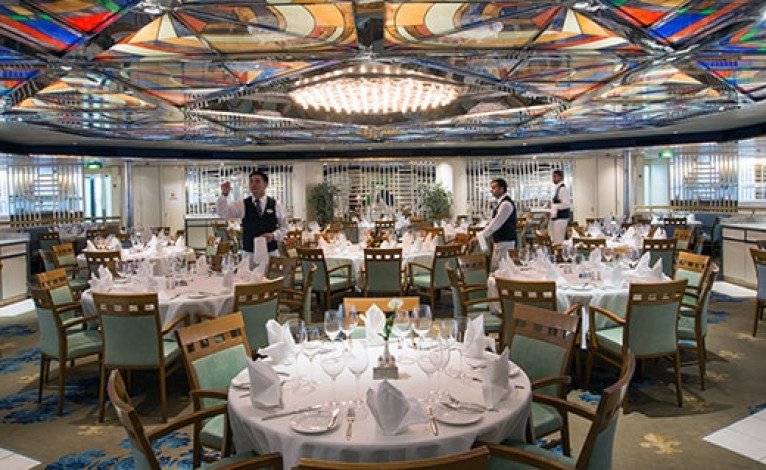
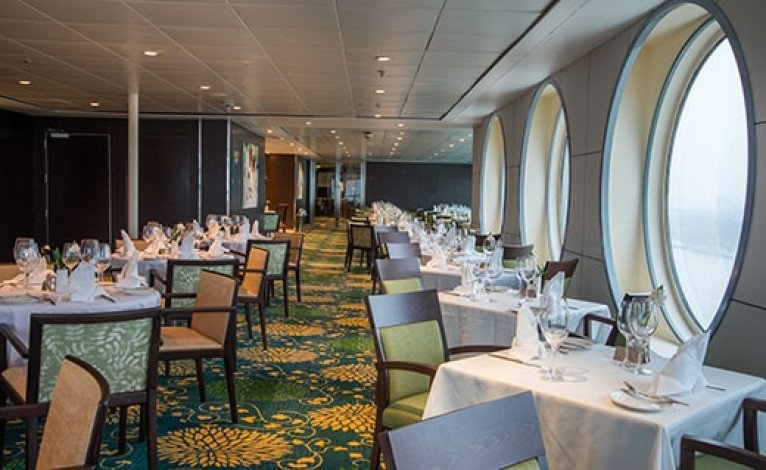
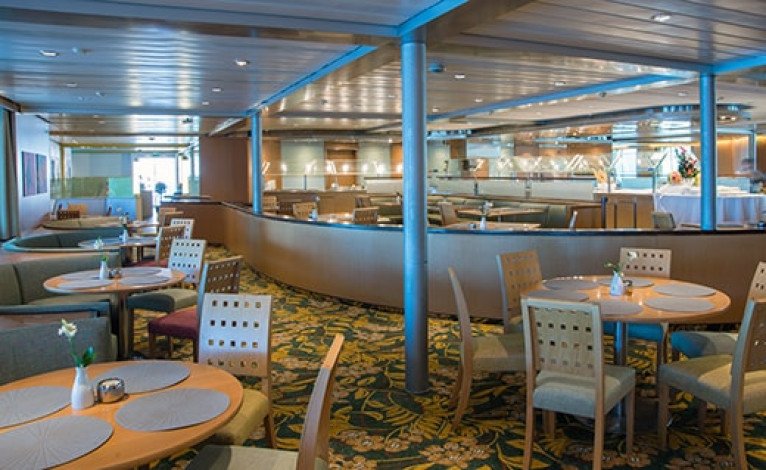
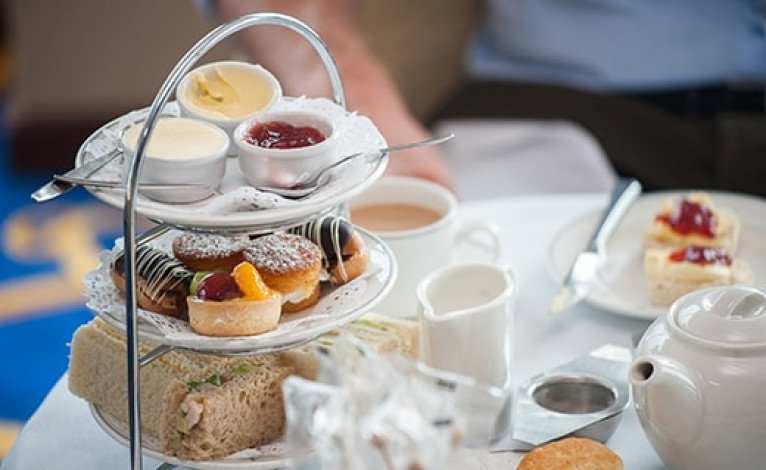
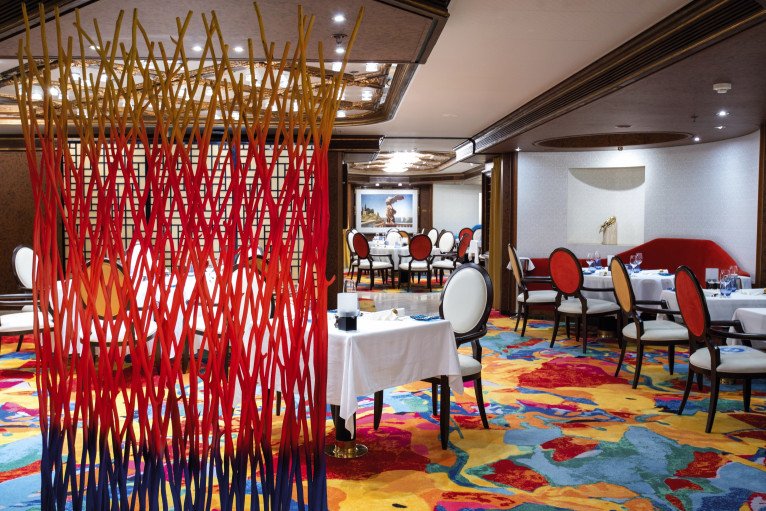
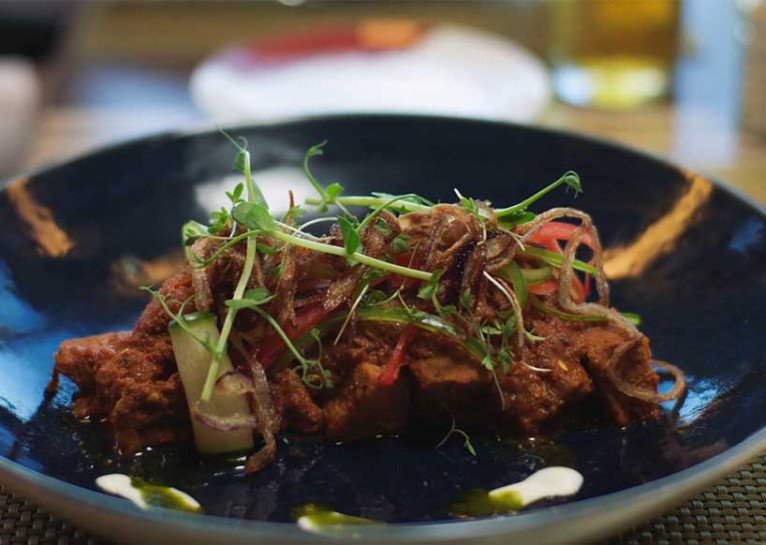
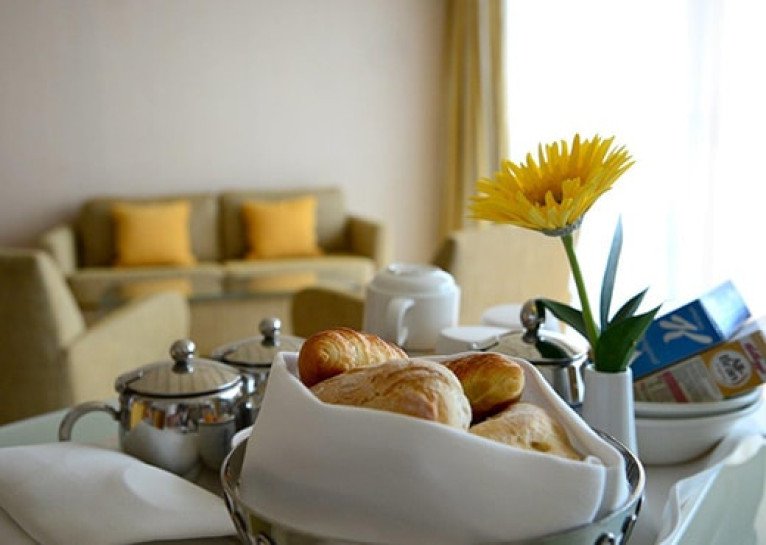
Ballindalloch Restaurant
Balmoral’s Ballindalloch restaurant offers a fantastic selection of expertly prepared delicious dishes to enjoy. Our delicious five-course á la carte menu changes each evening and is served to you by our attentive and friendly waiting teams.
Choose from mouthwatering steaks, perfectly cooked seafood and freshly made soups; all accompanied by bread baked on board each day. Take the chance to sample our featured Treats of the Region dishes, created in line with some of the destinations you are visiting on your Fred. Olsen cruise.

Spey & Avon Restaurants
The Spey and Avon restaurants have been carefully designed to really make the most of the large windows providing natural light and ever-changing views as you enjoy the same delicious five-course á la carte menus that are on offer at the main Ballindalloch restaurant. Freshly cooked breads and soups are on offer, along with succulent steaks, pasta dishes and melt-in-the-mouth desserts. There'll also be treats of the region dishes available for you to try, which are influenced by the destinations you're visiting.
The Bookmark Café
The Bookmark Café serves a selection of delicious speciality coffees and quality tea blends. Enjoy a quiet moment with a book or share the experience with good conversation, accompanied by our heavenly fresh chocolates and baked treats. From pralines to Champagne truffles, these mouth-wateringly good treats are too good to miss. If you'd like to make use of your Bookmark Café card - just £25 for 7 hot drinks and a bag of delicious truffles - then our friendly Baristas will be happy to fill your reusable cup with the drink of your choice, to enjoy on a stroll around deck or as you explore ashore.
Traditional Afternoon Tea
Each day complimentary afternoon tea is served in the Thistle Restaurant with sandwiches, scones and cakes, along with fresh tea and coffee. During selected sea days, guests can book our Traditional Premium Afternoon Tea* experience, with a selection of premium teas served in porcelain teapots, along with elegant finger sandwiches, pastries and warm scones with jam and clotted cream. These can be enjoyed alongside beautiful views from the Observatory Lounge, with musical accompaniment from our on board pianist and the careful attention of white-gloved waiters.
*Booking ahead is highly recommended for all our Speciality Dining options, and reservations can be made using the pre-book button in your 'My Cruises' account from 13 weeks before and up to 1 day prior to departure. Please note, there is a £15 per person supplement for Colours & Tastes. Speciality dining booked on board is chargeable at £20 per person*. Our Traditional Afternoon Tea Service is charged at £13 per person.
Colours & Tastes
Our Colours & Tastes restaurant features a tempting journey across Asia, blending bold spices, fresh flavours and the fragrant aromas of the East. From delicate stir-fries to rich curries and creative fusion dishes, every plate is crafted to excite the senses. Embrace the spirit of Italy, where timeless recipes and beautifully balanced flavours take centre stage, bringing together comforting pastas, bright seasonal notes and thoughtfully prepared sauces; or experience the full flavour of the grill, where every steak is hand-cut by our in-house butcher, selected by the chef, seasoned with precision and perfectly seared to lock in the flavours. From juicy, succulent steaks and tender, meaty prawns, to delicious plant-based steaks. Each plate delivers the deep, satisfying tastes of an exceptional grill experience.
Colours & Tastes will offer Asian, Grill and Italian menus on a rotation basis.
The price to book before you cruise will be £20pp, or £25pp if booked on board.
Thistle Restaurant
The Thistle Restaurant is designed with a light and airy feel, offering guests a more informal and relaxed dining experience, boasting a fresh layout, with stylish soft furnishings. The casual, self-serve dining experience with table-service drinks is perfect for those who prefer not to dine at a set time in the Ballindalloch, Spey and Avon restaurants, or those looking to indulge in a late night snack. You can expect to find an abundance of indulgent dishes, expertly prepared by our on board chefs, with various breakfast, lunch and dinner options, and a tasty selection of complimentary afternoon teas with sandwiches, scones and tempting cakes. There will also be the opportunity to try various dishes in our Treats of the Region section, which are local to the destinations you're visiting on your Fred. Olsen cruise.
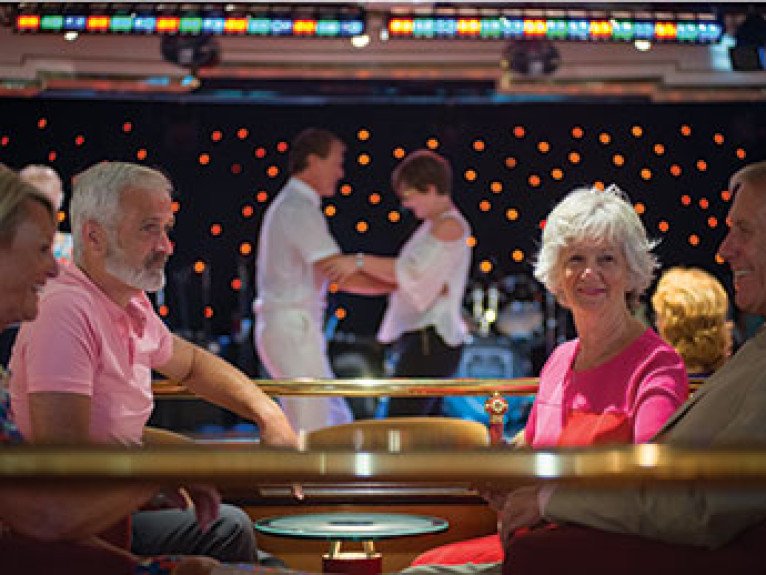
Room Service
All of our suites and cabins have tea and coffee making facilities included as standard, so you can enjoy a pick-me-up first thing or a relaxing drink at the end of the day. Continental breakfast can be ordered in advance for delivery at your preferred time, while snacks are available from 10am onwards.
For those times when you’d like a little something more, you can also order room service* up until 11pm every day. Choose from a delicious selection of dishes, including soups, salads, sandwiches such as a turkey club or grilled cheese, or hot bites of burgers, hot dogs, and pizzas, followed by sweet treats like chocolate fudge cake or New York cheesecake.


Guest Speakers
We're often joined on board our ships by port experts and guest speakers to talk our guests through a range of subjects and topics, such as history, geography, aviation, wine tasting and foods of the world.
On all cruises our informative Port Talks will be available for our guests to enjoy in preparation for arrival into each port. Our knowledgable lecturers share information to help guests make the most of their time ashore, while on some sailings, there are lectures that delve deeper into specific destinations on the itinerary too.
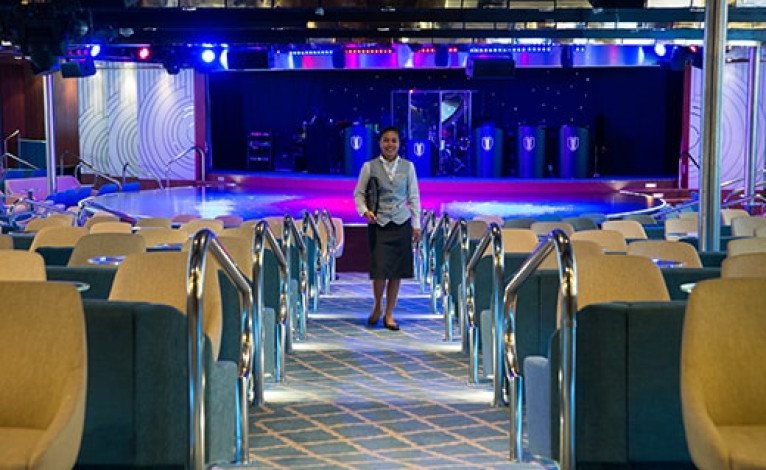
Dance Classes
For many of our guests, the time spent on the dance-floor is one of the highlights of their days on board our smaller ships. So its no wonder that our Dance Classes – hosted by our wonderful Entertainment teams – always prove popular.Show less
Our instructors teach a variety of dancing styles, from line dancing to ballroom and sequence dancing, helping guests to learn and perfect their steps and moves before they head for their ship's lounges in the evening to dance the night away.
Tasting Events
Hosted by our Sommeliers, Tasting Sessions* on board our smaller ships offer a fascinating insight into the production processes, scents and flavours of some of the world's finest tipples.Show less
The Tasting Sessions on your cruise could include opportunities to sample everything from delicious wines and Champagne to whiskey and a range of spirits, while occasionally our experts will also teach you the art of pairing food and drink to create combinations that perfectly blend the nuances of their flavour.
*To join our Tasting Sessions, there is an additional charge and this can vary on the type tastings on offer, full details can be found in your Daily Times once on board.
Travels to Come
Unlike other cruise companies who sail the same routes year after year, we are constantly researching and hand-crafting new itineraries. On every cruise we run a programme designed to inspire travel, where you can find out about the development of our new itineraries. Don't worry, these are not sales talks or "exit through the gift shop" ruses - just an opportunity for travel enthusiasts to daydream about what is yet to come.
Fred. Olsen Book Club
With ample time and space to relax, many of our guests make the most of the opportunity to get stuck in to a good book during a cruise holiday on board one of Fred. Olsen’s smaller, friendlier ships. This is why to enhance reading enrichment further, we have introduced the Fred. Olsen Book Club on selected sailings, a chance to talk all things ‘bookish’ with like-minded people.
Hosted by the Cruise Directors and their Team, the Book Club provides a welcoming, social space in which you can openly and informally discuss thoughts and views on bestselling lighter reads, crime-thrillers and traditional or contemporary classics. Specific categories and titles to discuss at the Book Club on each cruise are chosen in advance and listed below, allowing you time to purchase the books or download them to your kindle, and read them before you set sail.
So, if you love a good book while discovering the world with Fred. Olsen, what better way to indulge your passion than joining your friends and fellow guests at the Book Club?
To enhance your Book Club experience even further, why not enjoy a delicious speciality coffee as you immerse yourself in your book with our Bookmark Bestseller card with 7 hot drinks (teas, coffees, or hot chocolates) for you to enjoy and a bag of milk or mixed truffles priced at just £25?
We look forward to welcoming you!
Behind the Scenes Tours
New - Our Behind the Scenes Tours!
Join us for an exclusive behind-the-scenes tour and discover the hidden secrets and challenges of running a cruise ship. You'll gain special access to areas usually off-limits to guests, offering a unique glimpse into the inner workings of our vessel. Venture into the Galley to see how our chefs prepare your delicious meals, learn what it takes to manage the stores and laundry room, and enjoy visits to the Engine Control Room and the Bridge. Throughout the tour, you will have the opportunity to meet and speak with our dedicated crew members, gaining insights into life on board and hearing their stories first-hand. You will also receive a keepsake lanyard and a professional photo to commemorate your adventure. To ensure the most enjoyable, immersive experience, we have limited this tour to just 12 spaces.
Approx. 2 hours | £49pp
The Olsen Art Studio
The Olsen Art Studio on board Balmoral embodies the Olsen family's love of art, providing a spacious area filled with arts and crafts items for a range of tasks. It's a location for people who enjoy painting or drawing at home and want to improve their talents while at sea, and it's also a welcoming venue for guests who may have enjoyed art in the past but haven't had the opportunity to pursue it again.
Classes and activities led by various instructors will be held in the studio, as well as providing an open place for guests to come and work on their own unique arts and crafts projects.


The Marquee Bar
With its large windows, spectacular glass roof and beautiful décor and furnishings, the Marquee Bar provides guests with the perfect place to relax or meet up with new found friends. With a selection of beers, wines and expertly-created cocktails available, it's the perfect venue for a pre or post-dinner drink, or for joining your fellow guests after enjoying a day ashore.
The Observatory
The Observatory has spectacular panoramic views and is a wonderful lounge to enjoy a drink in as you take a seat in one of the comfortable chairs by the lounge's large windows - ideal for our scenic cruising of points of interest, tiny islands and iconic sights that you'll observe from this perfect viewpoint. As we head into the evening, the Observatory comes to life with music and singing from our resident live bands, and you'll have the choice of a selection of champagnes, sparkling cocktails or mocktails to add an extra touch of glamour to your on board experience.
Lido Bar and Lounge
Our spacious and sociable Lido Lounge & Bar is the perfect place to enjoy a refreshing drink and chat with our friendly staff and your fellow guests. Popular both before and after dinner, the bar has large panoramic windows overlooking the aft pool, allowing natural light to flow through; while the lounge is perfect for enjoying music from our resident musicians.
Morning Light Pub
Named after one of the largest sailing ships owned by the Olsen family in 1892 and decorated to resemble a British pub, the Morning Light Pub has a welcoming atmosphere and traditional style. Open throughout the day and the evening, it’s the ideal place to relax and socialise with friends both old and new. Featuring a well-stocked bar with a collection of beer and cider, including both British and international classics, and a selection from independent breweries close to our office in Ipswich, sip a drink and listen to our resident singers and guitarists, or take part in the popular (and competitive!) Fred. Olsen quiz.
The Serenity Tea Room
The Serenity Tea Room has been designed with quiet beauty and gentle elegance in mind. The colours are pale and powder-soft, and the furnishings are inspired by Chinese silks and rare orchids. During the day, we serve a refreshing menu of unusual loose-leaf teas and herbal infusions from the East, or a rare tea-tasting experience where you can learn about each tea’s story and origin. Join us for a relaxing tea-inspired cocktail, such as the refreshing Lemongrass Mojito or Lime & Mint Mar-tea-ni, or a selection of cold beers including specialities from Japan, Singapore and Thailand. We also offer a non-alcoholic cocktail or two, based on Sri Lankan and Chinese teas.
Neptune Lounge
Join us in the Neptune Lounge as we put on memorable shows for you, along with guest comedians, singers and magicians who’ll delight and entertain you; and come along to our popular Captain’s Welcome and Farewell parties. During the day, the Neptune Lounge is used for our guest speakers who will share their knowledge with you, delivering fascinating talks and activities, designed to give you a deeper understanding of the destinations you’ll be visiting. It's also the perfect place to attend our 'Audience with...'sessions, where you can learn about how much work goes into our shows or hear about life as a ship's Captain or officer.
Card Room
Featuring plenty of card tables and comfortable chairs, the Card Room on board Balmoral provides guests with a quiet, relaxing space to enjoy a competitive hand or two, or simply a bit of fun. Bridge is always a popular pursuit on board, so you're sure to find players up for a challenge. On some cruises, Bridge tuition is on offer to help you develop your skills.
The Botanical Room
Designed in shades of lush greens and vibrant yellows, the Botanical Room aboard Balmoral offers a warm and inviting space for guests to unwind. Here, you can delve into a collection of magazines and books celebrating gardening, flowers, plant care, and the incredible diversity of flora around the world, in peaceful surroundings adorned with plush seating.
The Earth Room
Our serene Earth Room is designed for those inspired by and curious about our remarkable planet. Featuring a unique collection of books individually picked by Fred. Olsen, covering topics like evolution, climate change, recycling, carbon footprints, and fossil fuels, along with tips on how we can all live more sustainably. There are also videos to view and digital literature to read, all of which are intended to be thought-provoking and conversation starters, making the Earth Room ideal for small groups to discuss relevant issues or simply learn more about our extraordinary world.
Boutique Shopping
The shops on board Balmoral offer everything you may want or need during your time on board, whether you're treating yourself or a loved one to a holiday gift or simply needing some essentials. Visit the Boutique Shop for perfumes, colognes and much more at Duty Free prices, or select from our superb range of Fred. Olsen branded merchandise, including casual tshirts, jackets and gilets, tote bags and rucksacks, travel mugs for taking your coffee from the Bookmark Café ashore, or lanyards for your all-important cabin card, all at our dedicated Sea Cove shop. If you need essentials, you'll find everything from sun cream, shampoo and toothpaste to books and snacks too, and you could also bring home something special from the Jewellery Shop.


Pools & Jacuzzis
Keep fit by swimming a few lengths, or cool down after relaxing in the sunshine on deck in either of Balmoral’s large, heated saltwater pools. Located in the centre of Marquee Deck and at the stern of the ship on Lounge Deck, both pools are surrounded by open deck space and plenty of loungers, so are perfect for soaking up the sunshine or losing yourself in a good book. For blissful relaxation, head for the Jacuzzi and let the warm, bubbling water soak any cares away, while you chat with fellow guests.
Atlantis Spa and Salon
Our Atlantis Spa provides soothing surroundings for our guests relaxation and enjoyment. Large picture windows are perfect for offering scenic cruising points or ocean views, so indulge in the ultimate relaxation for the mind, body and soul in our tranquil setting as our Spa team on board Balmoral pamper you. With a wide range of luxurious treatments on offer, including massages, manicures, pedicures, relaxation treatments and hairdressing; you'll leave feeling completely energised and revitalised, or feeling fabulous with a new cut or style.
The Atlantis Spa can be pre booked 13 weeks in advance, via your My Cruises account.
Fitness Centre
If you enjoy working out, Balmoral's Fitness Centre is fully equipped with all the modern facilities and equipment you'd expect to find in your gym back home, including running machines, bikes, cross trainers, weight machines and free weights. On board Balmoral and across our fleet of ships, we run a variety of complimentary yoga, pilates or stretching classes in the Fitness Centre, which are suitable for everyone from beginners to regular gym-goers, run by our fully qualified Fitness Instructors. Join us for an invigorating Walk a Mile session or a relaxing sunrise pilates or yoga class out on deck. We also have circuits, fitball or legs, bums & tums sessions. Details of classes can be found in your Daily Times each day.
Or, treat yourself to Personal Training sessions with our fully qualified, friendly trainers, where you can receive a one-to-one programme tailored just to your needs.
Stay in shape on your holiday in our fully-equipped Fitness Centres on board our ships.
Our friendly, fully-qualified fitness instructors will be on hand to assist you on the treadmills, rowing machines, exercise bikes and free weights.
Why not take a fitness class? Guests can enjoy our complimentary yoga, aerobics, stretch and tone or pilates classes while cruising. Or, for a more relaxing workout, enjoy the sea views with the ‘walk a mile’ group, as you stroll your ship's deck at your a leisurely pace, or swim a few lengths of the pool.
Locations of the Fitness Centres on board each ship are as follows:
Balmoral - Highland Deck 10
Details of opening hours will be in your Daily Times. The minimum age to use the Fitness Centre is 18 years.
Personal Training & Fitness Classes
Personal training | 60 mins | £46 or 30 min | £23.50
Pilates | 45 mins | Complimentary
This low-impact exercise emphasises the use of your abdominal muscles, lower back, hips and thighs to help improve flexibility, build muscular strength and enhance movement.
Yoga | 45 mins | ComplimentaryThis class focuses on the core elements of flexibility, strength, power, and balance. You will be taken through a series of different poses to give your entire body a complete flexibility and toning workout.
Fitball | 45 mins | ComplimentaryThis core strengthening class is designed to improve your range of motion, strength, stability co-ordination and balance. Fitball provides a thorough workout which helps to develop a stronger core, correct posture and improve body alignment.
Dyna-Band | 45 mins | ComplimentaryResistance bands are easy to use, effective and perfect for beginners. Enabling you to focus on specific areas of your body, they are great for toning and sculpting muscles. Used correctly, they are also great for a full body workout.
Stretch & Relax | 45 mins | ComplimentaryThis series of slow and gentle, low-intensity exercises and stretches help to maintain your balance, improve flexibility and to relax and focus your mind.
Abdominal | 30 minsThis class is designed to improve the abdominal muscles which have a crucial role in posture, supporting the spine, stability and respiratory functions such as breathing.
Exercise To Music | 30 minsThis fun class combines a variety of techniques to offer a great low-impact cardio workout, improving the strength and movement of your muscles and joints, while promoting a healthy heart.
Legs, Bums & Tums | 30 mins
Great for building and strengthening key muscles, this class includes a combination of movements to target the lower body, shaping and toning your lower body while improving flexibility.
Please note some classes have a limited capacity and can only be booked once on board with the Reception in The Atlantis Spa.
Nutrition
Body composition analysis | 45 mins | £32.50Body composition analysis is a physical test that accurately measures your body fat and the amount of lean tissue you have, which includes your muscle, water, bone and organs. Accurate assessment of body composition allows you to plan sensible nutrition and exercise programmes based on your body fat and lean tissue percentage.
Food Detective™ | 45 mins | £98This is a blood test that measures IgG antibodies which may be linked to inflammatory conditions in the body, manifesting in a range of health issues. You don’t have to send off a sample and wait weeks to receive results, simply visit the Atlantis Spa for a Food Detective™ check instead. Simple, safe, accurate and fast. Food Detective™ is the world’s first test for food intolerance.
Nutrition consultation | 45 min | £26
Fitness Classes
Whilst a Fred. Olsen cruise is about relaxing and enjoying some time away from daily life, we understand that many of our guests like to continue their fitness routine even when they're on board our smaller ships.
This is why our ships feature fully-equipped Fitness Centres, and we offer a wide range of complimentary fitness classes - perfect for beginners and experience gym-goers alike - too. Guests can join our instructors for Pilates, Yoga, Fitball and much more, and all at no extra cost.
- Marquee Deck 11
- Highland Deck 10
- Bridge Deck 9
- Lido Deck 8
- Lounge Deck 7
- Main Deck 6
- Atlantic Deck 5
- Coral Deck 4
- Marina Deck 3
Marquee Deck 11
- Observatory
- Marquee Bar
- Jacuzzis
- Swimming Pool
- Sun Deck
- Games Court
- Golf Net
Highland Deck 10
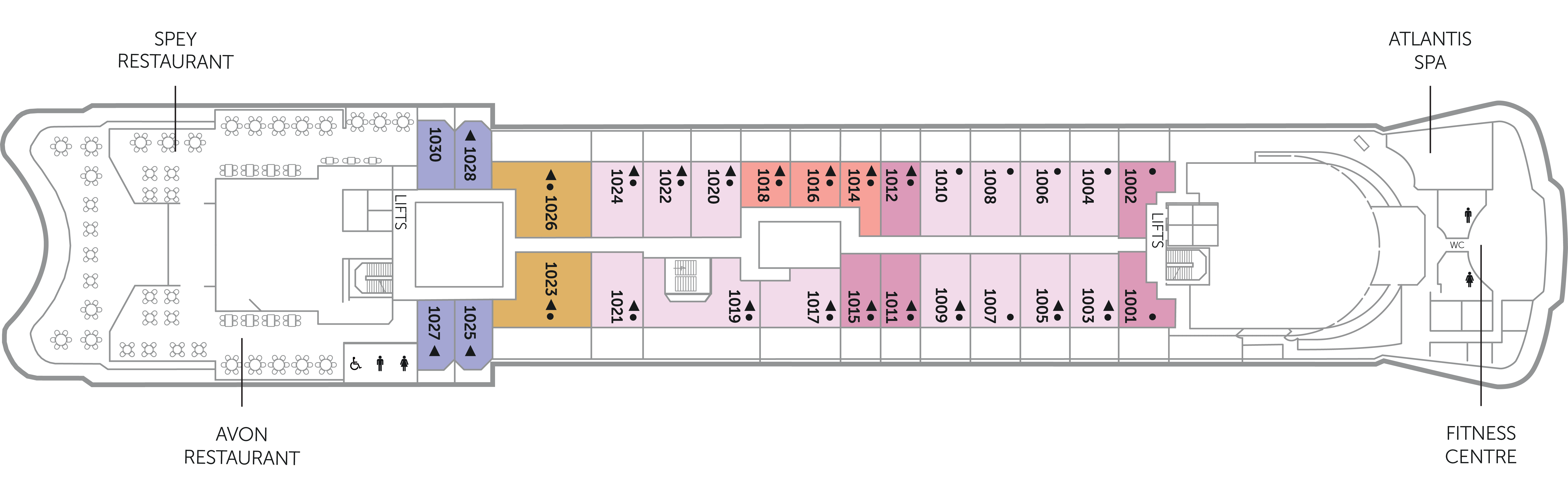
- Spey Restaurant
- Avon Restaurant
- Atlantis Spa
- Fitness Centre
- Owner's Suite
- Balcony Junior Suites
- Premier Suites
- Superior Suites
- Marquee Suites
Bridge Deck 9
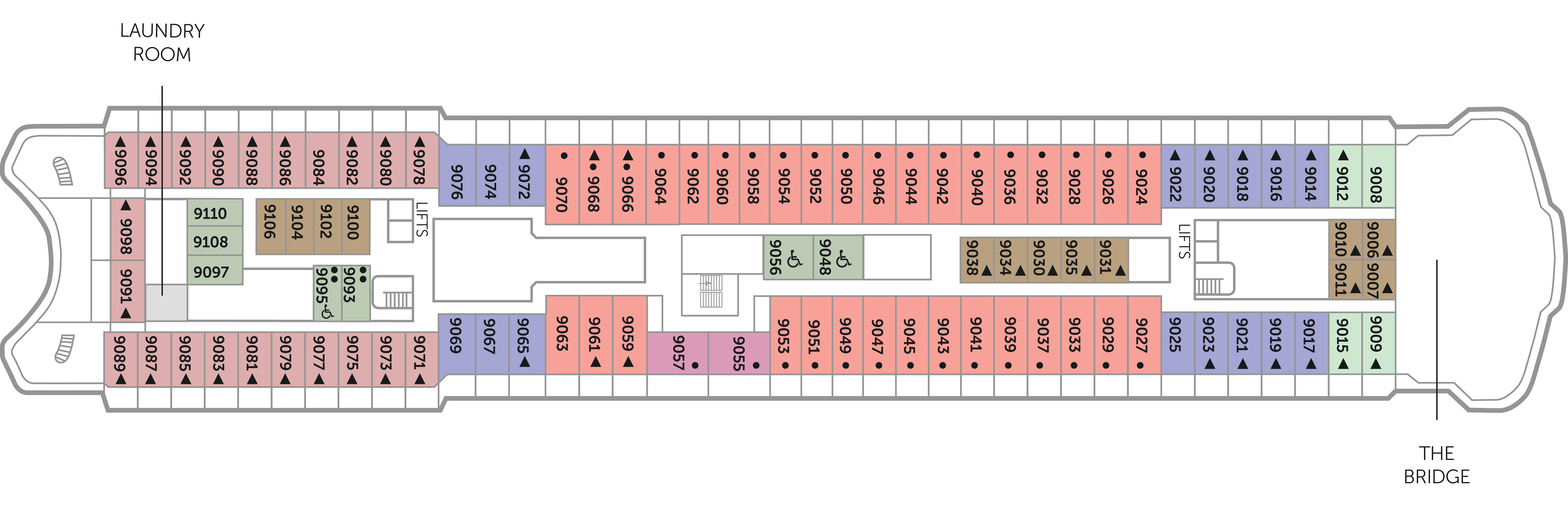
- Laundry Room
- The Bridge
- Balcony Cabins
- Superior Interior Cabins
- Single Interior Cabins
- Single Balcony Suite
- Balcony Junior Suite
- Superior Suite
- Marquee Suite
Lido Deck 8
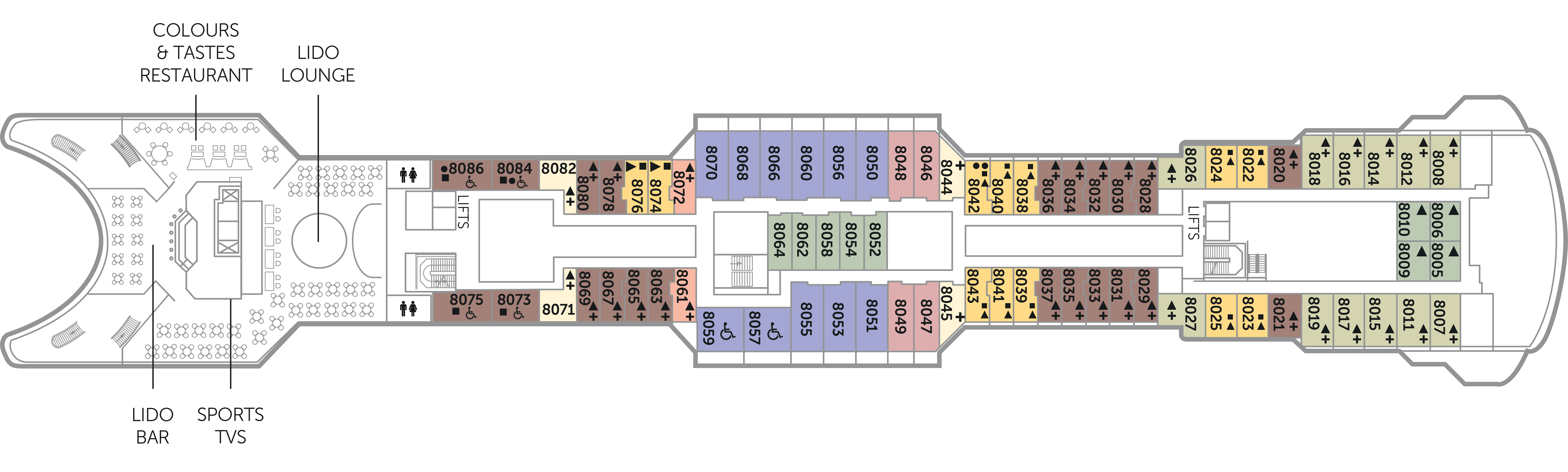
- Lido Bar
- Colours & Tastes Restaurant
- Lido Bar
- Sports TV
- Superior Ocean View Cabins
- Single Ocean View Cabins
- Single Superior Ocean View Cabins
- Balcony Junior Suites
- Superior Interior Cabins
- Balcony Cabins
Lounge Deck 7
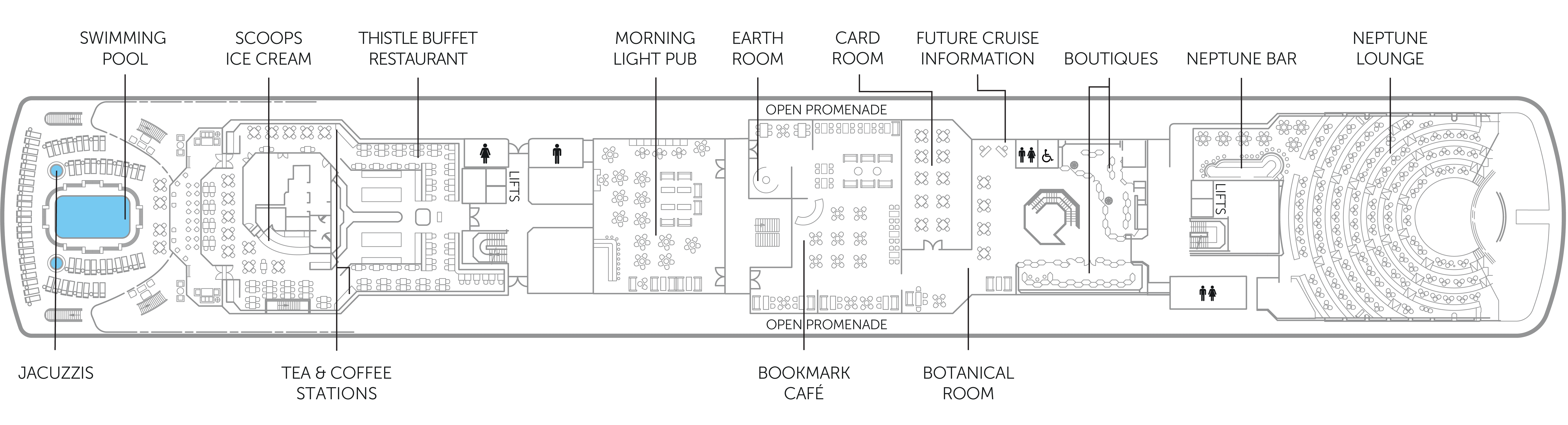
- Jacuzzis
- Swimming Pool
- Scoops Ice Cream
- Tea & Coffee Station
- Thistle Buffet Restaurant
- Morning Light Pub
- Earth Room
- Bookmark Café
- Card Room
- Open Promenade
- Botanical Room
- Future Cruise Information
- Boutiques
- Neptune Bar
- Neptune Lounge
Main Deck 6
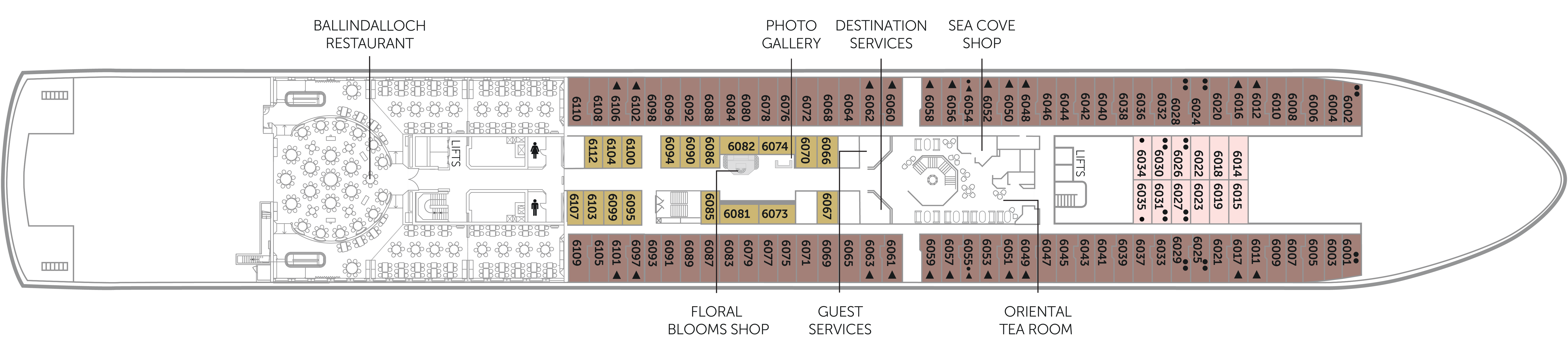
- Ballindalloch Restaurant
- Floral Blooms Shop
- Photo Gallery
- Guest Services
- Destination Services
- Sea Cove Shop
- Oriental Tea Room
- Superior Ocean View
- Single Interior Cabin
- Interior Cabin
Atlantic Deck 5

- Ocean View Cabins
- Interior Cabins
- Superior Ocean View Cabins
Coral Deck 4
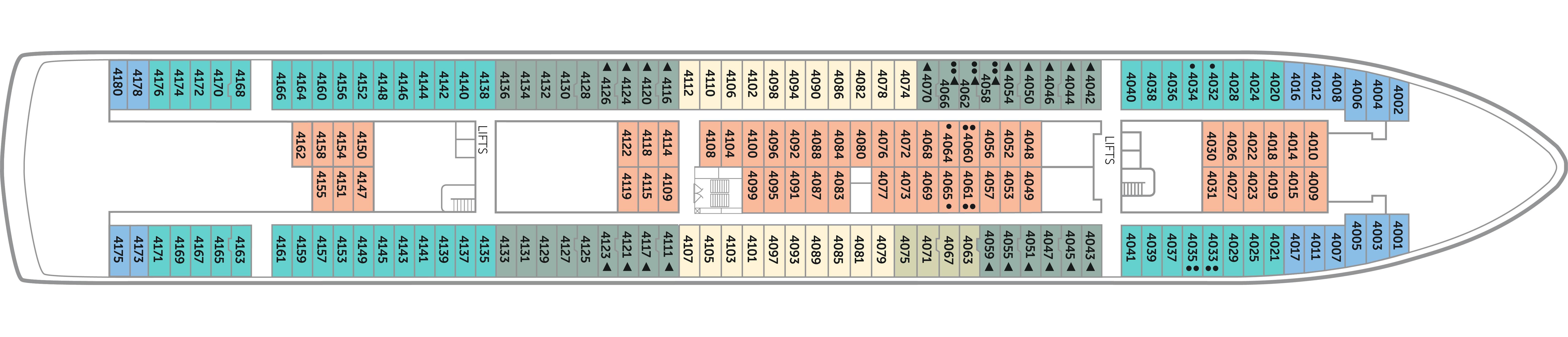
- Superior Ocean View Cabins
- Ocean View Cabins
- Interior Cabins
- Single Ocean View Cabins
Marina Deck 3

- Laundry Room
- Olsen Art Studio
- Medical Centre
- Single Ocean View Cabins
- Ocean View Cabins
- Interior Cabins
- Single Interior Cabins


Interior Cabin (H)
Featuring all the amenities and comforts guests need, and positioned close to stairs and lifts providing easy access to the ship's other decks and public areas, H Grade Interior cabins on Balmoral are perfect for a relaxing stay on board.
- Deck: Main Deck 6 & Atlantic Deck 5
- Size: 160 square feet (approx.)
- Bedroom with twin or double bed and a chair
- Bathroom with a shower
FLOORPLANS
Facilities
- Shower
- Room Service Available
- TV
- Hair Dryer
- Double or Twin Configuration
- Wi-Fi (Additional Cost)
- Safe
- Telephone
- Desk
Interior Cabin (I)
Featuring all the amenities and comforts guests need, and positioned close to stairs and lifts providing easy access to the ship's other decks and public areas, I Grade Interior cabins on Balmoral are perfect for a relaxing stay on board.
- Deck: Atlantic Deck 5, Coral Deck 4 & Marina Deck 3
- Size: 160 square feet (approx.)
- Bedroom with twin or double bed and a chair
- Bathroom with a shower
FLOORPLANS
Facilities
- Double or Twin Configuration
- Shower
- Toiletries Provided
- Room Service Available
- TV
- Wi-Fi (Additional Cost)
- Safe
- Hair Dryer
- Telephone
- Desk
Superior Interior Cabin (G)
Featuring all the amenities and comforts guests need, and positioned close to stairs and lifts providing easy access to the ship's other decks and public areas, G Grade Superior Interior cabins on Balmoral are perfect for a relaxing stay on board.
- Deck: Bridge Deck 9 & Lido Deck 8
- Size: 160 square feet (approx.)
- Bedroom with twin or double bed and a chair
- Bathroom with bath and/or shower
Please note: cabins 9048, 9056 and 9095 on Bridge Deck 9 are wheelchair accessible with a wetroom style en-suite.
FLOORPLANS
Facilities
- Shower
- Bath
- Room Service Available
- TV
- Hair Dryer
- Double or Twin Configuration
- Wi-Fi (Additional Cost)
- Safe
- Telephone
- Desk
Single Superior Interior (M)
Featuring all the amenities and comforts guests need, and positioned closed to stairs and lifts providing easy access to the ship's other decks and public areas, M Grade Single Superior Interior cabins on Balmoral are perfect for a relaxing stay on board.
- Deck: Bridge Deck 9
- Size: 160 square feet (approx.)
- Bedroom with a bed and a chair
- Bathroom with bath and/or shower
FLOORPLANS
Facilities
- One Single Bed
- Shower
- Bath
- Room Service Available
- TV
- Hair Dryer
- Wi-Fi (Additional Cost)
- Safe
- Telephone
- Desk
Single Interior Cabin (N)
Featuring all the amenities and comforts guests need, and positioned close to stairs and lifts providing easy access to the ship's other decks and public areas, N Grade Single Superior Interior cabins on Balmoral are perfect for a relaxing stay on board.
- Deck: Main Deck 6 & Marina Deck 3
- Size: 130 square feet (approx.)
- Bedroom with a bed and a chair
- Bathroom with a shower
FLOORPLANS
Facilities
- One Single Bed
- Shower
- Room Service Available
- TV
- Hair Dryer
- Wi-Fi (Additional Cost)
- Safe
- Telephone
- Desk


Ocean View (F)
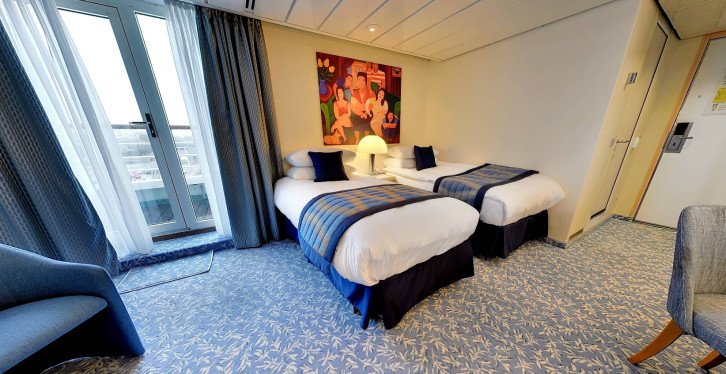
In addition to all the amenities needed for a comfortable, relaxing stay, the two porthole windows in Balmoral's F Grade Ocean View cabins also provide guests with plenty of soothing natural light and fantastic ocean views.
- Deck: Atlantic Deck 5, Coral Deck 4 & Marina Deck 3
- Size: 165 square feet (approx.)
- Bedroom with twin beds and a chair
- Bathroom with a shower
- Two porthole windows
FLOORPLANS
Facilities
- Twin
- Shower
- Room Service Available
- TV
- Wi-Fi (Additional Cost)
- Safe
- Hair Dryer
- Telephone
- Desk
Ocean View (D)
In a D Grade Ocean View cabin on Balmoral, guests will benefit from ample space in which to relax, all the amenities they need during their stay, plus plenty of natural light and scenic views provided by the cabin's picture window.
- Deck: Atlantic Deck 5 & Coral Deck 4
- Size: 165 square feet (approx.)
- Bedroom with twin beds and a chair*
- Bathroom with bath and/or shower
- Picture window
* Cabins 4125 and 4128 have a convertible double bed.
FLOORPLANS
Facilities
- Shower
- Bath
- TV
- Hair Dryer
- Double or Twin Configuration
- Room Service Available
- Wi-Fi (Additional Cost)
- Safe
- Telephone
- Desk
Ocean View (E)
In an E Grade Ocean View cabin on Balmoral, guests will benefit from ample space in which to relax, all the amenities they need during their stay, plus plenty of natural light and scenic views provided by the cabin's picture window.
- Deck: Coral Deck 4
- Size: 165 square feet (approx.)
- Bedroom with twin beds and a chair*
- Bathroom with a shower
- Picture window
*The following cabins have a convertible double bed: 4039, 4135, 4137, 4139, 4140, 4142, 4144, 4156 & 4164.
FLOORPLANS
Facilities
- Bath
- Double or Twin Configuration
- Shower
- Room Service Available
- TV
- Wi-Fi (Additional Cost)
- Safe
- Hair Dryer
- Telephone
- Desk
Single Balcony Cabin (J)
Situated higher on the ship, on Lido Deck 8, and featuring a balcony, Balmoral's J Grade Single Balcony cabins offer guests wonderful views, as well as ample space and all the amenities needed to rest, relax and enjoy their stay.
- Deck: Lido Deck 8
- Size: 218 square feet (approx.)
- Bedroom with double bed and a chair
- Bathroom with bath and/or shower
- Balcony
Please note: Cabins 8061 and 8072 have a small corner balcony (with a restricted view).
FLOORPLANS
Facilities
- Double or Twin Configuration
- Shower
- Toiletries Provided
- Room Service Available
- TV
- Wi-Fi (Additional Cost)
- Safe
- Hair Dryer
- Telephone
- Desk
Superior Ocean View (A)
Situated on Coral Deck 4, Atlantic Deck 5 and Lido Deck 8, these cabins feature large picture windows, Balmoral's A Grade Superior Ocean View rooms benefit from plenty of natural light and allow guests to enjoy scenic views in comfort from their own private space.
- Deck: Coral Deck 4, Atlantic Deck 5 & Lido Deck 8
- Size: 165-200 square feet (approx.)
- Bedroom with twin or double bed
- Bathroom with bath and shower
- Large picture window
FLOORPLANS
Facilities
- Shower
- Bath
- Room Service Available
- TV
- Hair Dryer
- Double or Twin Configuration
- Lounge Area
- Wi-Fi (Additional Cost)
- Safe
- Telephone
- Desk
Superior Ocean View (B)
Balmoral's B Grade Superior Ocean View cabins, in addition to all the amenities needed for a comfortable, restful stay, feature a picture window that provides guests with plenty of natural light and fantastic ocean views.
- Deck: Lido Deck 8 & Main Deck 6
- Size: 165 square feet (approx.)
- Bedroom with twin or double bed and a chair
- Bathroom with bath and/or shower
- Large picture window
*Cabins 8073, 8075, 8084 and 8086 on Lido Deck 8 are wheelchair accessible and have a fully restricted window.
FLOORPLANS
Facilities
- Shower
- Bath
- TV
- Safe
- Hair Dryer
- Double or Twin Configuration
- Room Service Available
- Wi-Fi (Additional Cost)
- Telephone
- Desk
Superior Ocean View (C)
For a light, airy feel, and to provide guests with fantastic ocean views, Balmoral's C Grade Superior Ocean View cabins feature a picture window, in addition to all the amenities needed for a comfortable stay on board.
- Deck: Atlantic Deck 5
- Size: 165 square feet (approx.)
- Bedroom with twin or double bed and a chair
- Bathroom with bath and/or shower
- Picture window
FLOORPLANS
Facilities
- Shower
- Bath
- TV
- Hair Dryer
- Double or Twin Configuration
- Room Service Available
- Wi-Fi (Additional Cost)
- Safe
- Telephone
- Desk
Single Ocean View (K)
In a K Grade Ocean View cabin on Balmoral, guests will benefit from ample space in which to relax, all the amenities they need during their stay, plus plenty of natural light and scenic views provided by the cabin's picture window.
- Deck: Coral Deck 4 and Lido Deck 8
- Size: 165 square feet (approx.)
- Bedroom with bed and a chair
- Bathroom with a shower
- Picture window
Please note that some of the K grades have 2 beds, but are sold as a Single Ocean View cabin.
FLOORPLANS
Facilities
- One Single Bed
- Shower
- Room Service Available
- TV
- Hair Dryer
- Wi-Fi (Additional Cost)
- Safe
- Telephone
- Desk
Single Ocean View (L)
In addition to all the amenities needed for a comfortable, relaxing stay, the porthole window in Balmoral's L Grade Single Ocean View cabins also provide guests with plenty of soothing natural light and fantastic ocean views.
- Deck: Marina Deck 3
- Size: 140 square feet (approx.)
- Bedroom with bed and a chair
- Bathroom with a shower
- Single porthole window
FLOORPLANS
Facilities
- One Single Bed
- Shower
- Room Service Available
- TV
- Hair Dryer
- Wi-Fi (Additional Cost)
- Safe
- Telephone
- Desk
Single Balcony Suite (JB)
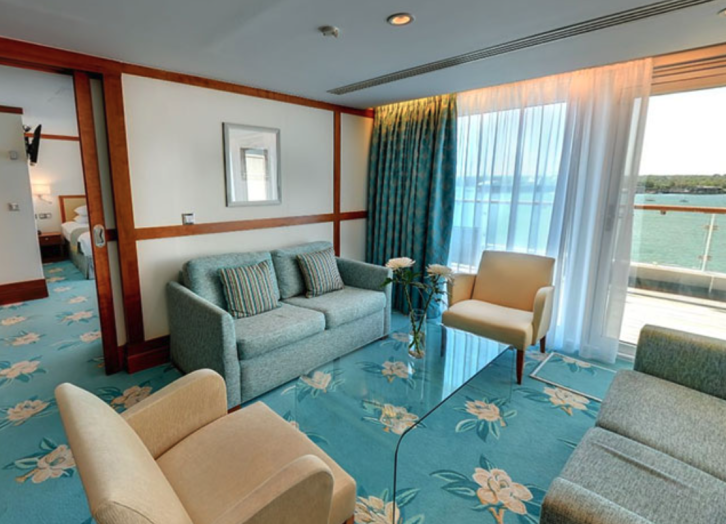
A welcoming, comfortable space in which to enjoy a relaxing, restful stay, Balmoral's Single Balcony Suites have all the amenities that guests need during their time on board, plus a private balcony for soaking up sunshine and scenery outside.
- Deck: Bridge Deck 9
- Size: 270 square feet (approx.)
- Bedroom with single bed
- Sitting area
- Bathroom with bath/shower
- Private balcony
- Large windows
- Guests benefit from complimentary Suite Dreams package
*Please note that some of the JB grades have 2 beds, but are sold as Single Balcony Suites.
SUITE DREAMS PACKAGE
Offered with our compliments in all our Suites, our Suite Dreams package includes a few little luxuries to make your time on board Balmoral even more special.
Priority check-in** and a bottle of sparkling wine will ensure you're perfectly relaxed when you are first welcomed into your suite. Daily canapés and a fruit basket are also available, as are comfortable bathrobes and slippers. Binoculars are on hand, along with a world atlas, for you to use - ideal for our Scenic Discoveries, where you'll marvel at the beautiful islands, lochs and seascapes Balmoral will cruise past
With our compliments on selected Suite grades.
- Priority check-in
- A welcome bottle of sparkling wine
- Fruit basket (topped up on request throughout your cruise)
- Flowers or plant in your Suite
- Bathrobe and slippers
- Luxury towels
- Free pressing service for formal wear
- Binoculars in your Suite
- World atlas and country guide for your reference
- Afternoon canapé service
- Daily newsletter, featuring national and international news
- Pair of compact umbrellas for use ashore
- Laundry service discount vouchers
- Carafe of water, replenished daily
*Facilities (including cabin layout) vary by Suite type; please check when making your booking. Suite Dreams benefits are available on all cruises of three nights and above duration. Suite Dreams benefits apply to guests staying in all Suite grades.
FLOORPLANS
Facilities
- One Single Bed
- Shower
- Bath
- Room Service Available
- TV
- Hair Dryer
- Lounge Area
- Double or Twin Configuration
- Suite Benefits
- Wi-Fi (Additional Cost)
- Safe
- Telephone
- Desk
Balcony Cabin (BA & BC)
Situated on Lido Deck 8 and Bridge Deck 9, Balmoral's Balcony Cabins feature a private balcony on which guests can enjoy the sunshine and scenery in their own outdoor space. Inside, the cabins are spacious and welcoming, and feature all the amenities needed for comfortable stay.
- Deck: Lido Deck 8 and Bridge Deck 9
- Size: 248 - 260 square feet (approx.)
- Bedroom with twin or double bed
- Sitting area
- Bathroom with bath and/or shower
- Private balcony
- Large windows
FLOORPLANS
Facilities
- Shower
- Bath
- Room Service Available
- TV
- Hair Dryer
- Double or Twin Configuration
- Lounge Area
- Wi-Fi (Additional Cost)
- Safe
- Telephone
- Desk


Owner's Suite (OW)
The spacious and tastefully decorated Owner's Suites on Balmoral are approximately 1181 square feet in size and are situated on Highland Deck 10. These suites feature all the amenities guests may need, with plenty of room, and a full length balcony, plus a few extra touches for a comfortable and memorable stay.
- Deck: Highland Deck 10
- Size: 1181 square feet (approx.)
- Bedroom with twin or double bed
- Separate sitting area
- Separate dining area
- Bathroom with bath and shower
- Walk in wardrobe
- Private balcony with large table, chairs and sun loungers
- Large floor-to-ceiling windows
- Access to your mini bar and food & drink cooler
- Guests benefit from complimentary Suite Dreams package
SUITE DREAMS PACKAGE
Offered with our compliments in all our Suites, our Suite Dreams package includes a few little luxuries to make your time on board Balmoral even more special.
Priority check-in** and a bottle of sparkling wine will ensure you're perfectly relaxed when you are first welcomed into your suite. Daily canapés and a fruit basket are also available, as are comfortable bathrobes and slippers. Binoculars are on hand, along with a world atlas, for you to use - ideal for our Scenic Discoveries, where you'll marvel at the beautiful islands, lochs and seascapes Balmoral will cruise past
With our compliments on selected Suite grades.
- Priority check-in
- A welcome bottle of sparkling wine
- Fruit basket (topped up on request throughout your cruise)
- Flowers or plant in your Suite
- Bathrobe and slippers
- Luxury towels
- Free pressing service for formal wear
- Binoculars in your Suite
- World atlas and country guide for your reference
- Afternoon canapé service
- Daily newsletter, featuring national and international news
- Pair of compact umbrellas for use ashore
- Laundry service discount vouchers
- Carafe of water, replenished daily
*Facilities (including cabin layout) vary by Suite type; please check when making your booking. Suite Dreams benefits are available on all cruises of three nights and above duration. Suite Dreams benefits apply to guests staying in all Suite grades.
FLOORPLANS
Facilities
- Double or Twin Configuration
- Lounge Area
- Dining Area
- Shower
- Room Service Available
- Mini Bar (Additional Cost)
- TV
- Safe
- Hair Dryer
- Telephone
- Desk
- Exclusive
Premier Suite (PS)
The spacious, elegantly-styled Premier Suites on Balmoral are approximately 601 square feet in size and situated high on the ship on Highland Deck 10. These suites feature all the amenities guests need, plus a few extra touches for an even more comfortable, restful and memorable stay.
- Deck: Highland Deck 10
- Size: 601 square feet (approx.)
- Bedroom with twin or double bed
- Separate sitting area
- Bathroom with bath/shower
- Private balcony with large table, chairs and sun loungers
- Large floor-to-ceiling windows
- Access to your mini bar and food & drink cooler
- Guests benefit from complimentary Suite Dreams package
SUITE DREAMS PACKAGE
Offered with our compliments in all our Suites, our Suite Dreams package includes a few little luxuries to make your time on board Balmoral even more special.
Priority check-in** and a bottle of sparkling wine will ensure you're perfectly relaxed when you are first welcomed into your suite. Daily canapés and a fruit basket are also available, as are comfortable bathrobes and slippers. Binoculars are on hand, along with a world atlas, for you to use - ideal for our Scenic Discoveries, where you'll marvel at the beautiful islands, lochs and seascapes Balmoral will cruise past
With our compliments on selected Suite grades.
- Priority check-in
- A welcome bottle of sparkling wine
- Fruit basket (topped up on request throughout your cruise)
- Flowers or plant in your Suite
- Bathrobe and slippers
- Luxury towels
- Free pressing service for formal wear
- Binoculars in your Suite
- World atlas and country guide for your reference
- Afternoon canapé service
- Daily newsletter, featuring national and international news
- Pair of compact umbrellas for use ashore
- Laundry service discount vouchers
- Carafe of water, replenished daily
FLOORPLANS
Facilities
- Lounge Area
- Shower
- Bath
- Room Service Available
- TV
- Hair Dryer
- Double or Twin Configuration
- Dining Area
- Suite Benefits
- Mini Bar (Additional Cost)
- Wi-Fi (Additional Cost)
- Safe
- Telephone
- Desk
Marquee Suite (MS)
At approximately 472 square feet in size, Balmoral's Marquee Suites provide guests with ample space in which to relax, and feature all of the amenities – as well as a few extra benefits – that are needed for a comfortable and enjoyable cruise experience.
- Deck: Highland Deck 10 (forward)
- Size: 472 square feet (approx.)
- Bedroom with large double bed
- Separate sitting area
- Bathroom with bath/shower
- Private balcony with sun loungers
- Large floor-to-ceiling windows
- Access to your mini bar and food & drink cooler
- Guests benefit from complimentary Suite Dreams package
Offered with our compliments in all our Suites, our Suite Dreams package includes a few little luxuries to make your time on board Balmoral even more special.
Priority check-in** and a bottle of sparkling wine will ensure you're perfectly relaxed when you are first welcomed into your suite. Daily canapés and a fruit basket are also available, as are comfortable bathrobes and slippers. Binoculars are on hand, along with a world atlas, for you to use - ideal for our Scenic Discoveries, where you'll marvel at the beautiful islands, lochs and seascapes Balmoral will cruise past
With our compliments on selected Suite grades.
- Priority check-in
- A welcome bottle of sparkling wine
- Fruit basket (topped up on request throughout your cruise)
- Flowers or plant in your Suite
- Bathrobe and slippers
- Luxury towels
- Free pressing service for formal wear
- Binoculars in your Suite
- World atlas and country guide for your reference
- Afternoon canapé service
- Daily newsletter, featuring national and international news
- Pair of compact umbrellas for use ashore
- Laundry service discount vouchers
- Carafe of water, replenished daily
FLOORPLANS
Facilities
- Lounge Area
- Shower
- Bath
- Room Service Available
- TV
- Hair Dryer
- Double or Twin Configuration
- Suite Benefits
- Mini Bar (Additional Cost)
- Wi-Fi (Additional Cost)
- Safe
- Telephone
- Desk
Superior Suite (SS)
Balmoral's Superior Suites, at approximately 341 square feet in size, provide guests with plenty of space in which to relax and enjoy their time on board. Each suite features all the amenities needed for a comfortable stay, as well as a few additional benefits.
- Deck: Highland Deck 10 & Bridge Deck 9 (midship)
- Size: 341 square feet (approx.)
- Bedroom with twin or double bed
- Separate sitting area
- Bathroom with bath/shower
- Private balcony with sun loungers
- Large floor-to-ceiling windows
- Access to your mini bar and food & drink cooler
- Guests benefit from complimentary Suite Dreams package
Offered with our compliments in all our Suites, our Suite Dreams package includes a few little luxuries to make your time on board Balmoral even more special.
Priority check-in** and a bottle of sparkling wine will ensure you're perfectly relaxed when you are first welcomed into your suite. Daily canapés and a fruit basket are also available, as are comfortable bathrobes and slippers. Binoculars are on hand, along with a world atlas, for you to use - ideal for our Scenic Discoveries, where you'll marvel at the beautiful islands, lochs and seascapes Balmoral will cruise past
With our compliments on selected Suite grades.
- Priority check-in
- A welcome bottle of sparkling wine
- Fruit basket (topped up on request throughout your cruise)
- Flowers or plant in your Suite
- Bathrobe and slippers
- Luxury towels
- Free pressing service for formal wear
- Binoculars in your Suite
- World atlas and country guide for your reference
- Afternoon canapé service
- Daily newsletter, featuring national and international news
- Pair of compact umbrellas for use ashore
- Laundry service discount vouchers
- Carafe of water, replenished daily
FLOORPLANS
Facilities
- Lounge Area
- Shower
- Bath
- Room Service Available
- TV
- Hair Dryer
- Double or Twin Configuration
- Suite Benefits
- Mini Bar (Additional Cost)
- Wi-Fi (Additional Cost)
- Safe
- Telephone
- Desk
Balcony Junior Suite (BJ)
A welcoming, comfortable space in which to enjoy a relaxing, restful stay, Balmoral's Balcony Junior Suites have all the amenities that guests need during their time on board, plus a private balcony for soaking up sunshine and scenery outside.
- Deck: Highland Deck 10, Bridge Deck 9 & Lido Deck 8
- Size: 279 square feet (approx.)
- Bedroom with twin or double bed
- Sitting area
- Bathroom with bath and/or shower
- Private balcony
- Large windows
- Guests benefit from complimentary Suite Dreams package
Please note, cabins 8057 and 8059 on Lido deck are wheelchair accessible cabins
SUITE DREAMS PACKAGE
Offered with our compliments in all our Suites, our Suite Dreams package includes a few little luxuries to make your time on board Balmoral even more special.
Priority check-in** and a bottle of sparkling wine will ensure you're perfectly relaxed when you are first welcomed into your suite. Daily canapés and a fruit basket are also available, as are comfortable bathrobes and slippers. Binoculars are on hand, along with a world atlas, for you to use - ideal for our Scenic Discoveries, where you'll marvel at the beautiful islands, lochs and seascapes Balmoral will cruise past
With our compliments on selected Suite grades.
- Priority check-in
- A welcome bottle of sparkling wine
- Fruit basket (topped up on request throughout your cruise)
- Flowers or plant in your Suite
- Bathrobe and slippers
- Luxury towels
- Free pressing service for formal wear
- Binoculars in your Suite
- World atlas and country guide for your reference
- Afternoon canapé service
- Daily newsletter, featuring national and international news
- Pair of compact umbrellas for use ashore
- Laundry service discount vouchers
- Carafe of water, replenished daily
*Facilities (including cabin layout) vary by Suite type; please check when making your booking. Suite Dreams benefits are available on all cruises of three nights and above duration. Suite Dreams benefits apply to guests staying in all Suite grades.
FLOORPLANS
Facilities
- Lounge Area
- Shower
- Bath
- Room Service Available
- TV
- Hair Dryer
- Double or Twin Configuration
- Suite Benefits
- Wi-Fi (Additional Cost)
- Safe
- Telephone
- Desk